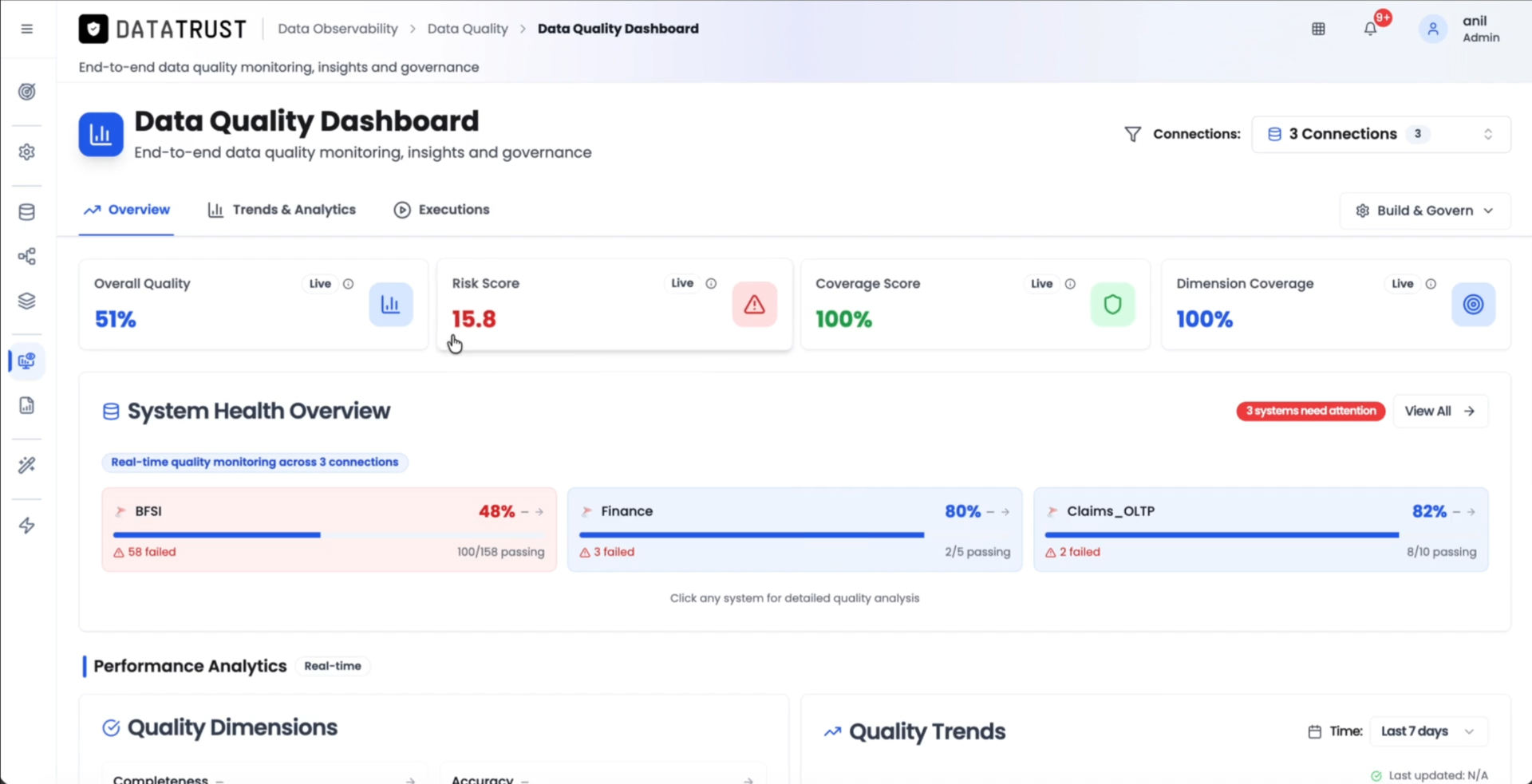
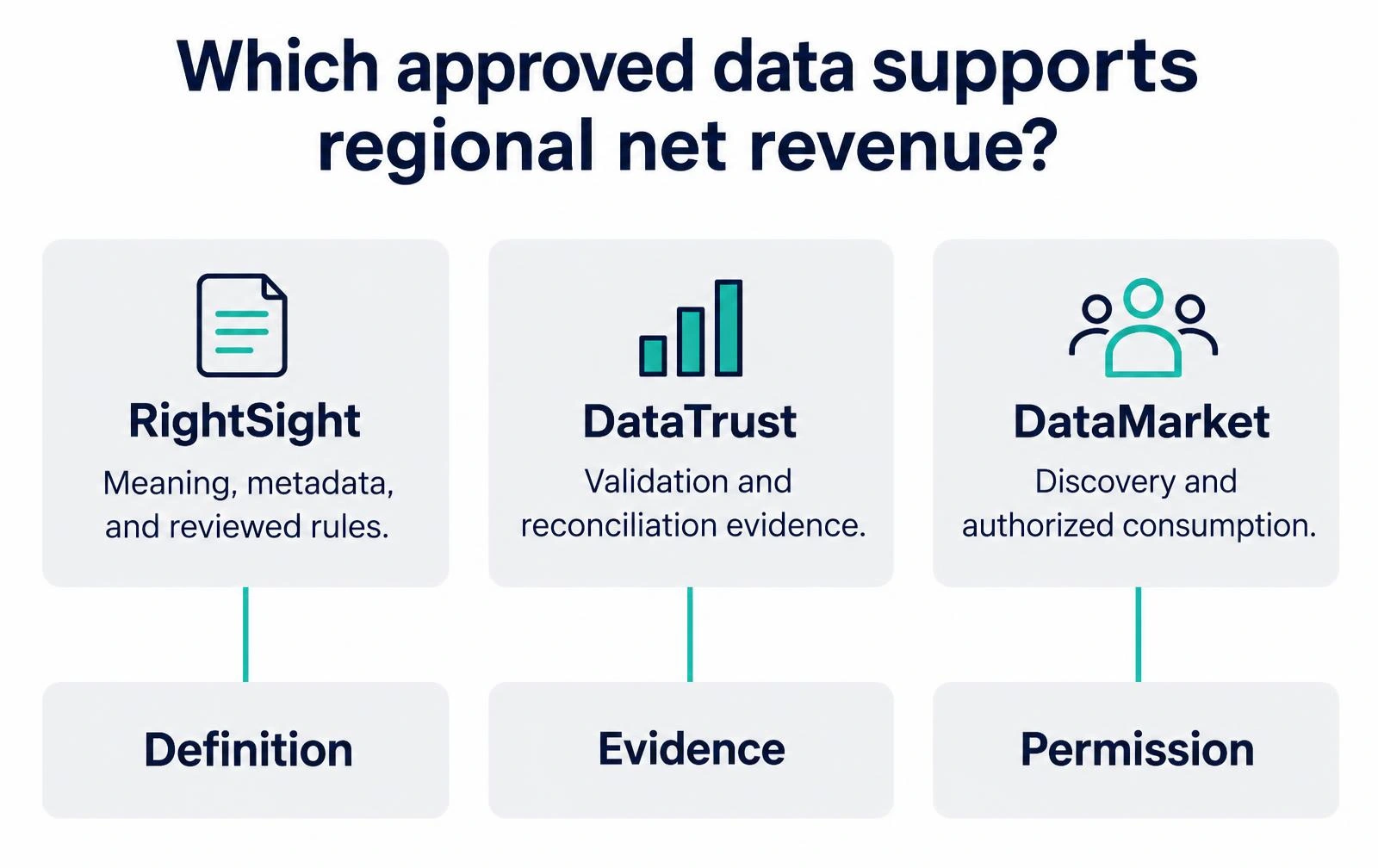
RightData brings together three products with distinct responsibilities. RightSight provides metadata, governance, profiling, and quality rule context. DataTrust focuses on continuous data quality assessment and controls, validation, ETL testing, and reconciliation. DataMarket supports discovery and authorized consumption of governed data products.
The practical question is how those responsibilities support a business decision. A dataset needs meaning and ownership, evidence that it meets relevant requirements, and an appropriate path for the intended user to consume it.
Start with one reporting question
Consider an illustrative finance team asking, “Which approved dataset should I use for regional net revenue?” Three problems can block a useful answer. The team may not agree on the meaning of net revenue, may not know whether the latest load passed the required controls, or may lack permission to use every region.
Treat those as connected requirements. A searchable name alone does not resolve them, and a passing technical test alone does not establish authorization.
RightSight establishes metadata and governance context
RightSight helps teams work with metadata, business terms, profiling, and reusable quality rules. That context connects an asset's technical structure with its business meaning and accountable owners.
For the revenue example, document the approved definition, exclusions, relevant fields, and relationships. Profiling can expose missing values or unusual patterns that warrant investigation. AI-assisted rule work should retain a review step so a suggested rule is assessed against the intended use before it becomes an approved requirement.
Metadata change analysis can support questions about what changed and what may be affected. Coverage depends on the configured extraction, supported sources, and captured relationships; a missing dependency must not be interpreted as proof that no dependency exists.
DataTrust supplies validation and reconciliation evidence
DataTrust focuses on continuous DQA and DQC: data quality assessment and data quality controls. It supports requirements around validation, ETL testing, and source to target reconciliation.
For the revenue example, define the reporting population, transformation, key, comparison window, and permitted differences. A useful result explains whether the expected records and amounts agree, which exceptions remain, and what execution evidence supports the conclusion.
Continuous controls can be scheduled around the business process. They should not be described as a guarantee of real-time detection or as a generic observability dashboard. Confirm execution frequency, source impact, supported connections, and evidence handling for the actual implementation.
DataMarket supports governed discovery and use
DataMarket helps users discover and access governed data products, including through natural language exploration. The consumption experience should preserve the organization's configured permissions and access scope.
An analyst assigned to the West region may need a different permitted view from an enterprise finance leader. The same business question should not override that distinction. Discovery of an asset also does not automatically authorize access to its underlying data.
Show users the definition, ownership, relevant quality context, and access path associated with a data product. Validate the supported request, approval, masking, and consumption behavior in the intended configuration rather than assuming every workflow is identical.
Connect the responsibilities without assuming universal automation
| Business need | Product responsibility | Demonstration question |
|---|---|---|
| Understand the asset | RightSight metadata and governance context | Can the user identify its owner and approved business meaning |
| Test a critical requirement | DataTrust validation and reconciliation | Can a reviewer inspect the scoped result and unresolved exceptions |
| Find and use permitted data | DataMarket discovery and consumption | Does the result respect the user's defined access scope |
Discover → Govern → Validate → Deliver describes a useful business journey. It does not mean every implementation follows a single mandatory sequence or that all actions happen automatically. Owners, integrations, and review decisions still matter.
Use the catalog implementation guide, ETL testing guide, and data product tutorial to examine each responsibility in more detail.
Frequently asked questions
Which product should lead a reconciliation discussion
Start with DataTrust for validation and source to target reconciliation requirements. Include RightSight and DataMarket when metadata, approved rules, discovery, or consumption context is also needed.
Does DataMarket replace access controls
No. Governed consumption needs the organization's configured policies and supported enforcement path. Confirm how permissions apply to previews, queries, exports, and underlying systems.
Can an AI suggestion become a control without review
The intended governance workflow includes accountable review. A generated suggestion should be checked for meaning, scope, and valid exceptions before activation.
Request a Demo around one business question so the team can show the relevant product responsibilities and implementation boundaries.