ETL testing automation runs repeatable checks on data extraction, transformation, and loading so teams can assess whether a pipeline produces the expected result. A useful test suite checks the data as well as the job: which records arrived, how values changed, which relationships survived, and what evidence supports release.
A successful pipeline run is one input to that decision. It does not establish that an exchange rate was correct, a cancelled order was excluded, or every source record reached its intended destination.
Types of ETL testing
| Test type | What it checks |
|---|---|
| Source-to-target counts and values | Compare row counts and field values between source and target to find missing, extra or changed records. |
| Transformation logic | Verify that business rules, joins, aggregations and lookups produce the expected results. |
| Data type and format | Check that types, lengths, dates and codes match the target schema. |
| Duplicates and nulls | Find duplicate keys and unexpected empty values before they reach reports. |
| BI report checks | Compare report totals with the underlying data so dashboards show the right numbers. |
Start with a testable business outcome
Suppose a retailer loads order lines into a daily revenue table. The reporting requirement is: include completed orders for the agreed business day, exclude cancelled lines, convert currencies using the approved rate date, and subtract discounts before calculating net revenue. This is an illustrative example, not a RightData customer result.
Write the expected outcome before selecting checks. Specify the source extract, target version, business timezone, comparison keys, transformation rules, and late-arrival cutoff. A test without these boundaries can report a mismatch that reflects two different reporting windows rather than a defect.
Define the source to target contract
Use order_id plus line_id as the comparison key if that combination is unique in both systems. If the target is aggregated by day and region, first calculate an independent expected aggregate at that same grain. Comparing detailed source rows directly with an aggregated target will create misleading differences.
Record approved exclusions explicitly. For this example, cancelled lines are excluded by status, not silently removed because they fail to match. Missing exchange rates are exceptions that require review. They must not default to a convenient value that makes the test pass.
Build a small suite that exposes different failures
| Test | Exact expectation | Example failure | Release treatment |
|---|---|---|---|
| Scope | Compare completed orders for the same business day | Target includes a later day | Rebuild the comparison window |
| Keys | Each order_id and line_id pair is unique | One line appears twice | Block release until explained |
| Completeness | Every eligible source key appears in the expected target population | A completed order is missing | Investigate extraction and filters |
| Transformation | Net revenue equals quantity times unit price minus discount | Discount is added instead of subtracted | Correct the mapping and rerun |
| Relationships | Each order customer_id resolves to an approved customer record | Customer reference is absent | Route to the responsible owner |
| Reconciliation | Compare values at the agreed grain and currency basis | Totals match but two records differ | Review the record differences |
These checks answer different questions. A matching row count does not replace key matching. A matching total does not replace field comparisons where individual values matter.
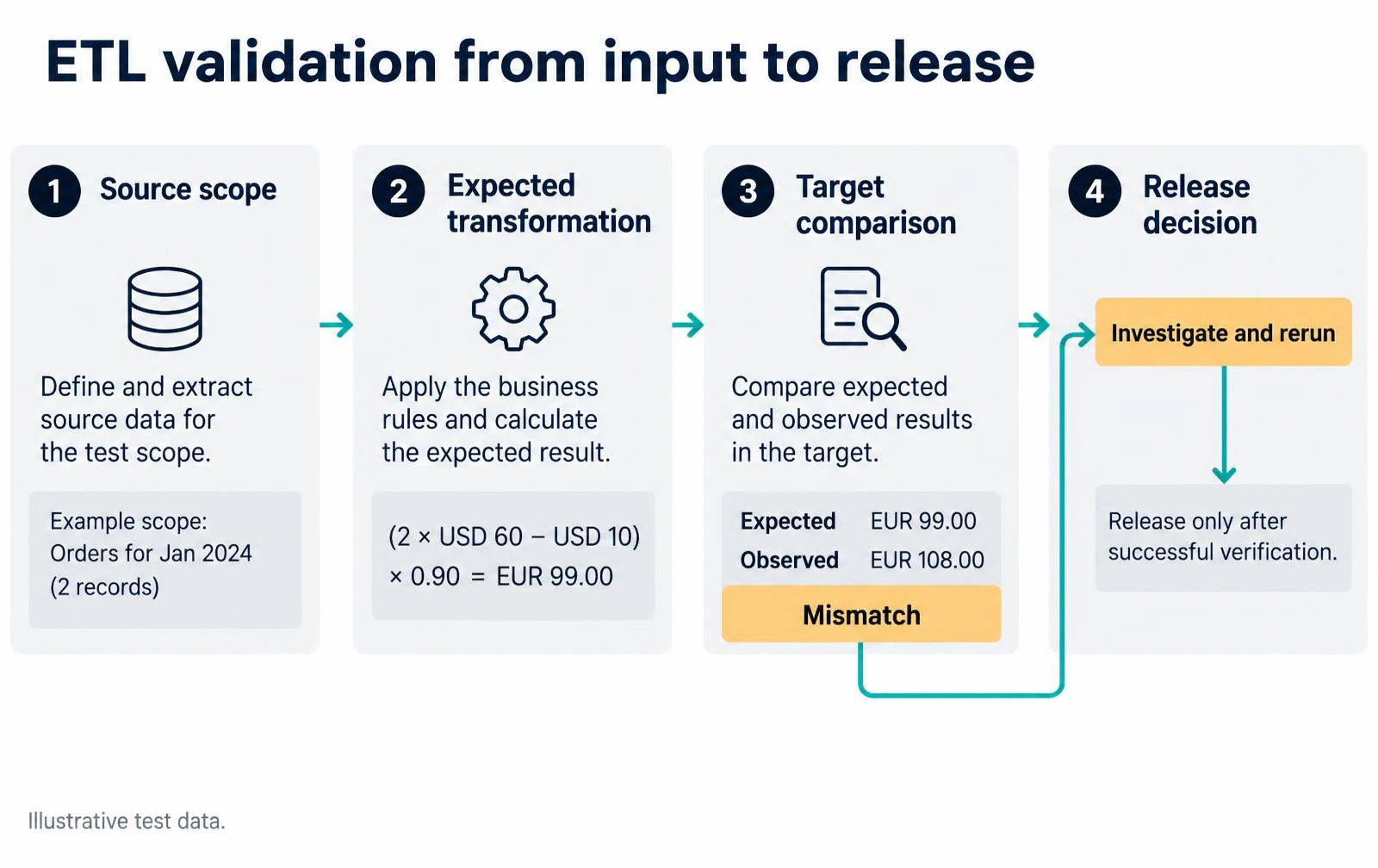
Test the expected business result, then retain the evidence behind the release decision.
Work through one transformation
Assume an order line has quantity 2, unit price USD 60, and discount USD 10. Expected net revenue is USD 110. If an approved conversion rate of 0.90 EUR per USD applies, the expected converted amount is EUR 99.00 before any further rounding rule.
A target value of EUR 108.00 may look reasonable while still being wrong: it converts the gross amount and ignores the discount. Retain the inputs, formula, rate reference, expected value, and observed value with the failed result. That record gives the engineer a specific mapping issue to investigate.
Define decimal precision and rounding order in the contract. A tolerance is an approved rule for an expected numerical difference. It is not a way to conceal an unexplained discrepancy. Separate rounding differences from missing records and incorrect business logic.
Automate execution and control exceptions
Run focused regression checks when a mapping, schema, reference table, or business definition changes. Run scheduled checks against completed loads using the agreed data cutoff. For incremental processing, test inserts, updates, deletes, replayed events, and late arrivals where they apply.
An execution should record the test version, input scope, timestamps, result, mismatched keys, and responsible owner. Route exceptions to an investigation queue with a decision: correct the data, correct the test, accept a documented difference, or stop the release. An accepted exception needs a reason, an approver, and an expiry or review condition.
Keep the release gate separate from the existence of a test. Teams need an agreed decision about which failed controls block release and which require review. Connect a testing tool to a deployment workflow only after verifying its supported interfaces and the behavior of the surrounding pipeline.
Extend ETL software testing to the BI result
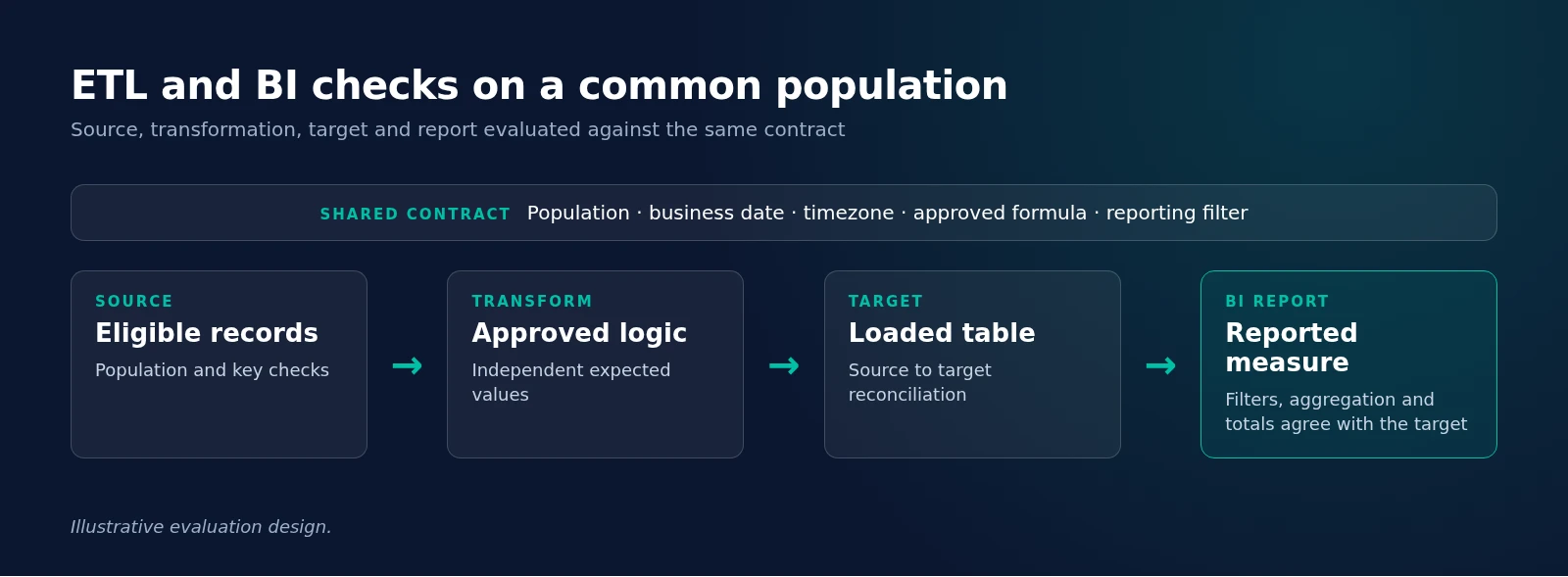
ETL software testing should follow the business requirement through extraction, transformation, loading and the report that uses the result. A correct warehouse table does not prove that a dashboard applies the intended joins, filters, aggregation or reporting period. Treat BI testing as a related downstream control with its own expected result.
Use a fictional order-line table containing three eligible lines with net values of 100, 50 and 25 USD. The expected regional total is 175 USD. First verify the eligible source keys and transformed warehouse values. Then compare the report output using the same region, time boundary and exclusions. If a report joins each line to two category rows and sums both matches, the total can double even though the warehouse values remain correct.
Record whether the report uses a live connection, an imported dataset or another refresh path. Align the observation times before comparing results. A warehouse loaded at 08:00 and a report refreshed at 07:00 describe different states. Reconcile them after the appropriate refresh before treating the difference as a transformation defect.
Evaluate ETL validation with DataTrust using a representative transformation and your required evidence. The ETL testing solution provides the use-case context.
What to look for in ETL testing tools
- Source-to-target reconciliation across databases, files and cloud data platforms
- Field-by-field comparison as well as fast bulk checks on large tables
- Reusable rules and test scenarios you can schedule and run in CI/CD
- Exception reports that show exactly which records differ
- Audit trails and sign-off for regulated reporting
Evaluate a platform with your own failure cases
Ask a vendor to demonstrate a missing record, an incorrect transformation, a duplicate key, a timing mismatch, and a rerun after correction. Evaluate connection permissions, execution impact, comparison granularity, exception workflow, and retrievable evidence. Use a representative dataset rather than relying on a generic feature checklist.
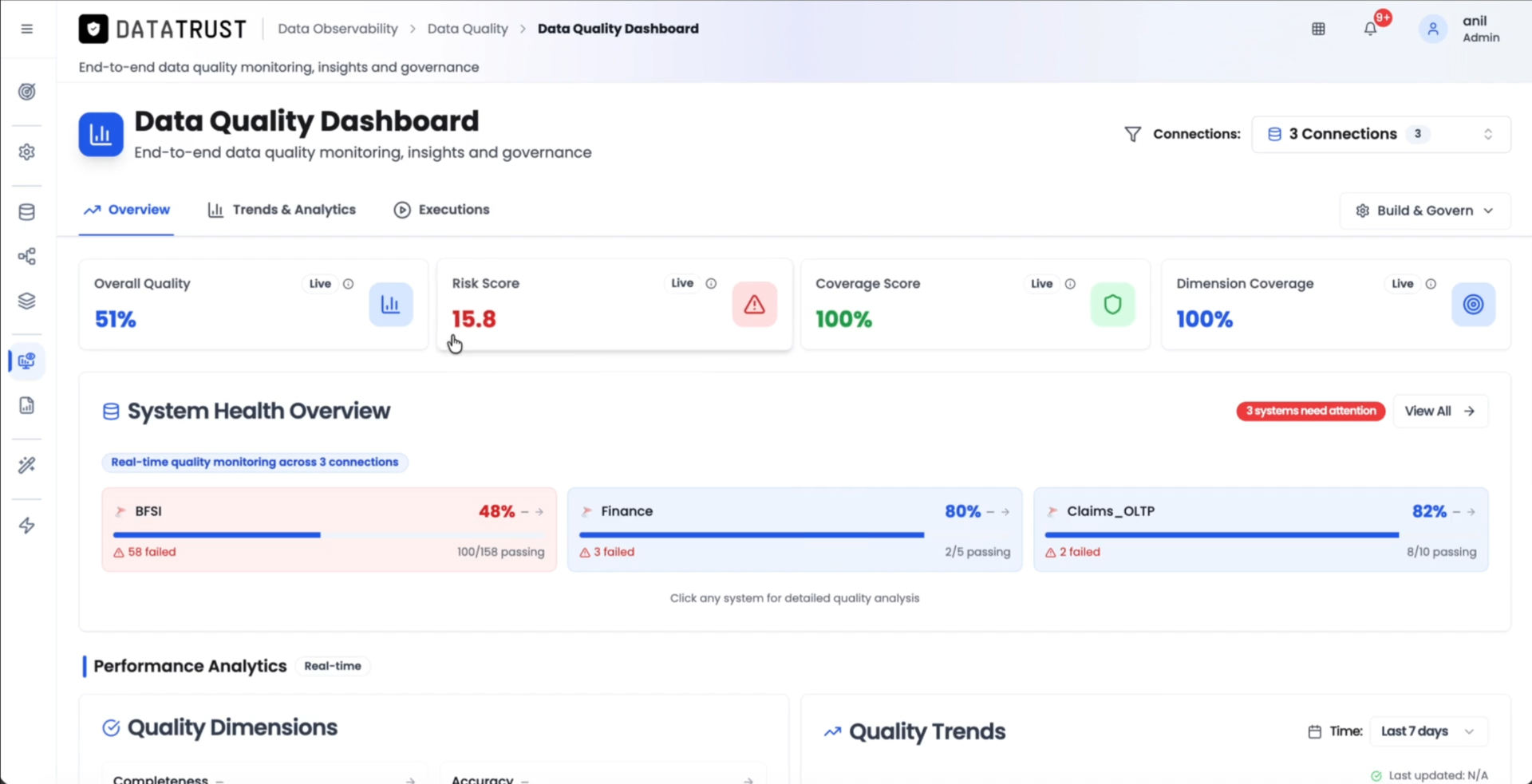
DataTrust focuses on continuous data quality assessment and controls, including validation, ETL testing, and source to target reconciliation.
For the broader implementation process, read automated data validation. For a cutover-specific control set, use the migration testing checklist.
Frequently asked questions
How is ETL testing automation different from job monitoring
Job monitoring reports whether processing ran and how it behaved. ETL testing checks the expected data outcome, including completeness, transformations, relationships, and reconciliation. Both are useful, and their coverage can overlap.
Which checks should run before a release
Start with the controls linked to material reporting or operational risk. Include the changed mapping, affected keys and relationships, critical calculations, and relevant regression checks. The release owner should approve the blocking criteria.
How should valid source to target differences be handled
Document the transformation, scope difference, timing rule, or tolerance that explains them. Record the approval and review condition. Do not normalize away unexplained differences merely to produce a passing result.
Is BI testing the same as ETL testing
They overlap in the data flow but check different stages. ETL testing evaluates extraction, mappings, transformations and loaded data. BI testing checks how the reporting layer selects, joins, aggregates and presents the resulting data. Use aligned populations and observation times when comparing the two.
Request a Demo to discuss an ETL testing and reconciliation scenario using your source systems, transformation rules, and release requirements.
Sources
Related products
Frequently asked questions
What is the difference between ETL testing and data quality testing?
ETL testing checks that data moved and transformed correctly between source and target. Data quality testing checks that the data itself is complete, valid and consistent, wherever it lives.
When should ETL tests run?
Run them whenever pipelines change, as part of CI/CD, and on a schedule in production so issues are caught before reports are published.
Can ETL testing be automated?
Yes. Source-to-target comparisons, rule checks and report checks can be defined once and run automatically on a schedule or after every load.
What is source-to-target reconciliation?
It compares data in the source and target systems record by record or in aggregate, and reports anything missing, extra or different on either side.
See how DataTrust automates ETL testingExplore the ETL testing use case