A data catalog is essential for data discovery and governance. This practical guide walks you through building a catalog that your organization will actually use.
What is a Data Catalog
A data catalog is an organized inventory of data assets with the metadata needed to discover, understand, and use them effectively. It serves as the "Google for your data"-helping users find what they need without knowing where to look.
Core Functions:
Discovery: Finding relevant data assets
Understanding: Comprehending what data means
Trust: Knowing data quality and lineage
Access: Understanding how to get data
Governance: Managing policies and compliance
Step 1 Define Your Scope
Start with Questions:
What data domains are most critical?
Who are the primary users?
What problems are we solving?
What's the appropriate breadth vs. depth?
Practical Advice: Start focused. A catalog with 100 well-documented assets is more valuable than 10,000 poorly documented ones.
Step 2 Choose Your Platform
Build vs. Buy Considerations:
Build when:
You have unique requirements
Strong development resources available
Integration with custom systems is critical
Buy when:
You want faster time to value
Standard features meet your needs
You prefer vendor maintenance and updates
Evaluation Criteria:
Metadata management capabilities
Integration with existing tools
Search and discovery experience
Collaboration features
Governance and access controls
AI/ML capabilities
Step 3 Establish Metadata Standards
Technical Metadata (often automated):
Table and column names
Data types and sizes
Source systems and locations
Refresh schedules
Business Metadata (requires human input):
Business definitions and descriptions
Ownership information
Data quality indicators
Usage guidelines
Operational Metadata:
Lineage and dependencies
Access patterns
Quality metrics
Change history
Step 4 Populate the Catalog
Automated Collection:
Connect to source systems for technical metadata
Scan for schema information
Extract lineage from ETL tools
Integrate quality metrics
Manual Enrichment:
Add business definitions
Assign ownership
Document known issues
Create usage examples
Crowdsourced Content:
Enable user annotations
Collect usage feedback
Allow tagging and rating
Encourage knowledge sharing
Step 5 Enable Discovery
Search Capabilities:
Full-text search across all metadata
Faceted filtering (domain, type, quality)
Relevance ranking
Suggested terms
Navigation:
Browse by domain or category
Explore related assets
Follow lineage connections
View recent and popular items
AI Enhancement:
Natural language queries
Automated recommendations
Similar asset suggestions
Anomaly highlighting
Turn the pilot into a consumer acceptance test
Choose a task that matters to a named team. A useful fictional pilot is a finance analyst finding an approved monthly revenue product and explaining its scope. Define success before importing metadata: the analyst should identify the right asset, understand the metric and grain, find the accountable owner and complete the permitted next step.
Prepare one approved product, one superseded product and one similarly named but unsuitable dataset. Include a definition that requires clarification. These cases reveal whether the catalog helps consumers make a correct choice instead of merely returning a long search result list. Observe the task without supplying information that is missing from the catalog.
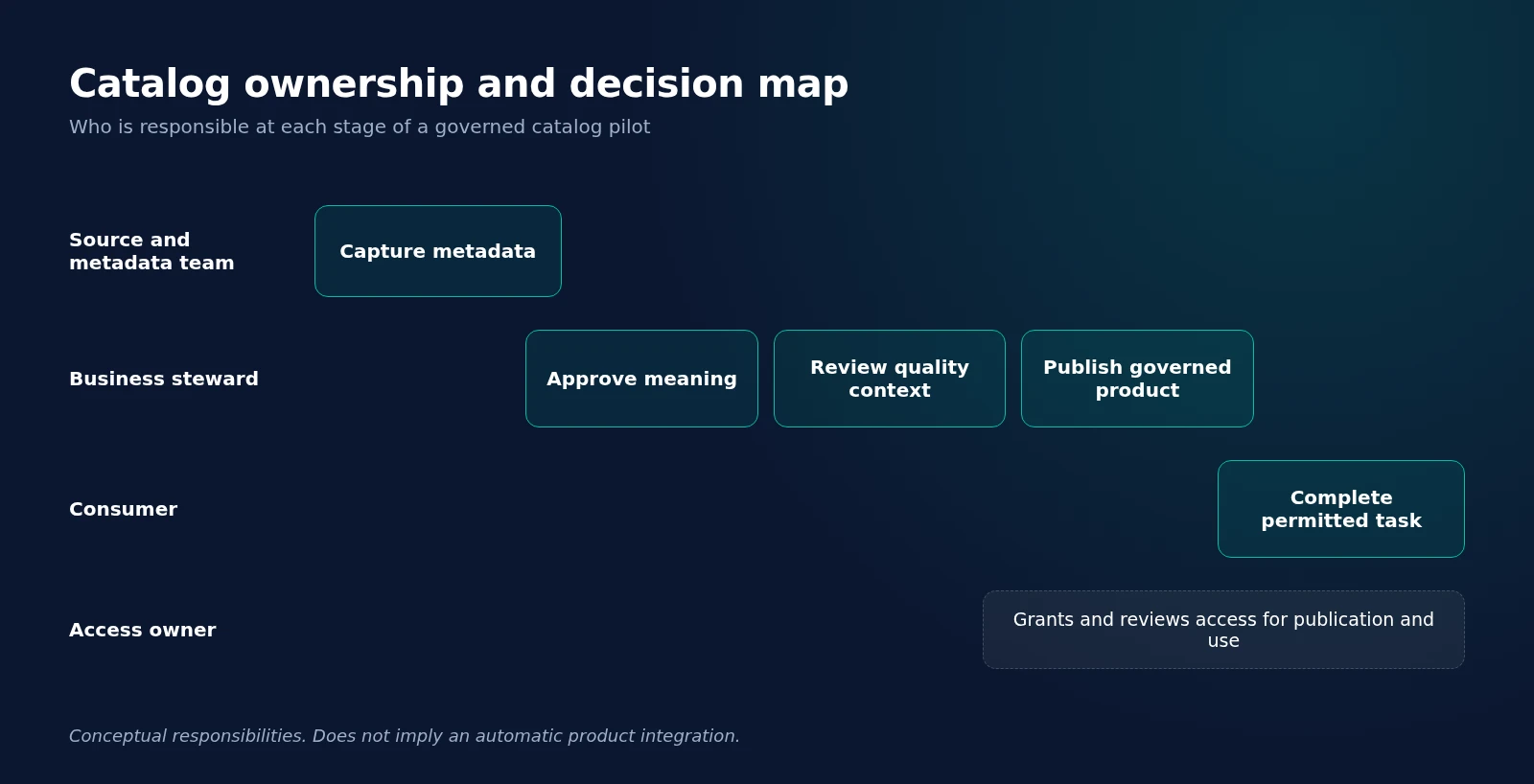
| Responsibility | Evidence maintained | Acceptance question |
|---|---|---|
| Source owner | Asset location, extraction scope and refresh information | Was the intended source population captured? |
| Business steward | Approved term, metric, exclusions and grain | Can the consumer explain what the product means? |
| Quality owner | Rule scope, observation time and known exceptions | Does the quality context address this use? |
| Access owner | Available request or consumption path | Can this user complete the permitted action? |
| Product owner | Pilot results and unresolved limitations | Is the product ready for the intended consumer task? |
Separate metadata preparation from consumer discovery
A catalog program needs reliable metadata before it can offer reliable discovery. Inspect the supported extraction job, confirm the imported objects and review descriptions against the actual source. Missing objects, stale scans and ambiguous definitions should have an owner. An extraction job finishing successfully does not establish that every required asset is documented.
RightSight brings metadata, business semantics, profiling and reusable quality-rule context into that preparation work. Use a representative source to review the metadata baseline and the relationship between terms, profiling results and reviewed rules. Keep AI-suggested descriptions and rules subject to the organization’s review process.
DataMarket addresses the consumer task of discovering and using governed data products. Evaluate whether a user can identify the right product, understand its approved meaning and follow the configured authorization path. Do not assume that a metadata entry automatically becomes a published, permitted data product. Confirm the handoff, supported integration and resulting context in the proposed configuration.
DataTrust supports continuous assessment, controls, validation and reconciliation. When its evidence informs a catalog or marketplace entry, retain the relevant dataset, rule and time window. A recent check on one table should not become a claim that an entire domain is suitable for every use.
Require evidence for changes after launch
Revisit the pilot when a source field, business definition, owner or access policy changes. Record what changed, which consumer tasks may be affected and whether the product needs a new review. Preserve a superseded definition with its effective period where it is needed to interpret historical results. Do not silently replace a definition used by earlier reports.
Use metadata and business context with RightSight to evaluate preparation, and governed data product discovery with DataMarket to evaluate consumption. Continue with active metadata management for change-driven action. Use the business glossary guide to define ownership and review requirements.
Step 6 Drive Adoption
Make It Valuable:
Ensure content is accurate and current
Make access request easy
Integrate with existing workflows
Show usage metrics to encourage participation
Promote Usage:
Train users on catalog features
Celebrate contributions
Share success stories
Integrate into onboarding
Maintain Quality:
Review content regularly
Flag stale entries
Track adoption metrics
Gather user feedback
Step 7 Govern and Evolve
Governance Processes:
Define content standards
Establish review workflows
Assign stewardship responsibilities
Integrate with access management
Continuous Improvement:
Monitor usage analytics
Collect user feedback
Expand scope systematically
Evaluate new capabilities
Common Pitfalls
Starting Too Big: Focus on high-value assets first
Neglecting Business Metadata: Technical metadata alone isn't enough
No Governance Model: Without stewardship, content degrades
Ignoring User Experience: If it's hard to use, people won't
One-Time Project Mindset: Catalogs require ongoing investment
Conclusion
Building a successful data catalog requires balancing technology, content, and adoption. Start focused, invest in quality over quantity, and treat the catalog as an ongoing program rather than a one-time project. Done well, a data catalog becomes an essential tool for data-driven organizations.
Frequently asked questions
What should a catalog pilot include
Include the assets, owners, definitions, quality context, and access path needed for a specific consumer task. Select enough coverage to complete that task without importing unrelated material.
Who should review AI-generated descriptions
An accountable owner or delegated steward should review business meaning, exclusions, sensitive content, and intended use. Technical metadata can inform that review without replacing it.
Is catalog discovery the same as access approval
No. Discovery explains what an asset is and how access may be requested. Actual use depends on configured authorization and the supported enforcement path.
How should a catalog pilot be accepted
Choose a consumer task and verify that representative users can find the appropriate asset, understand its approved definition and grain, identify its owner, inspect relevant quality context and complete a permitted next step. Include unsuitable and superseded assets so the evaluation tests correct selection.
How do RightSight and DataMarket fit a catalog program
RightSight provides metadata, business semantics, profiling and reusable rule context. DataMarket supports discovery and governed consumption of data products. Evaluate the supported handoff and configuration for the intended workflow rather than assuming that cataloging an asset grants access to its data.
Request a Demo to evaluate your catalog pilot with a representative consumer task and source scope.