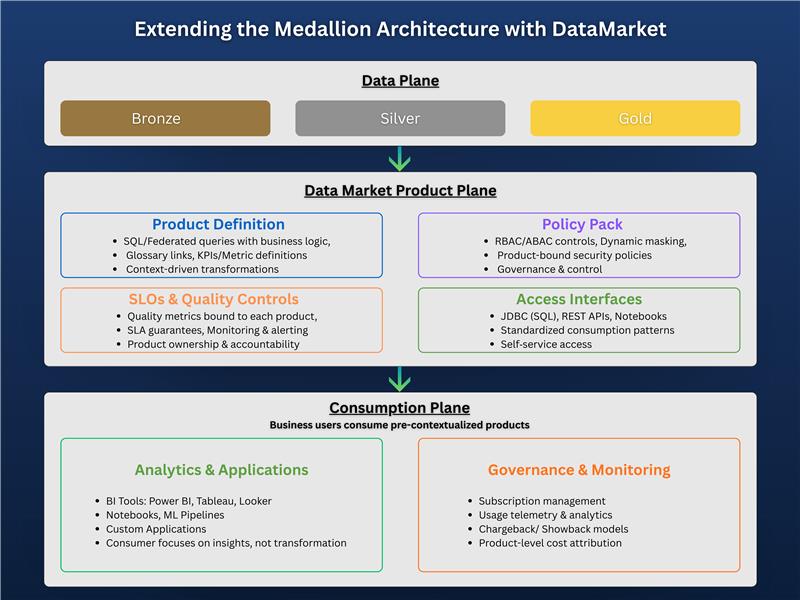
The Medallion Architecture has emerged as the standard blueprint for organizing data pipelines in modern enterprises. Built on the foundation of Bronze, Silver, and Gold layers, the Medallion Data Architecture enables teams to move from raw data ingestion to business-ready insights. However, as data ecosystems evolve, organizations are realizing that structured pipelines alone are not enough. They need data that is not only curated but also governed, discoverable, and consumable. This is where DataMarket complements the Medallion Architecture-not by replacing it, but by extending it into a true data product ecosystem.
Medallion Architecture Remains the Backbone
At its core, the Medallion Architecture continues to be your data engineering foundation. The Bronze, Silver, and Gold layers still form the pipeline that supports ingestion, standardization, and curation:
- Bronze Layer: Raw, unprocessed data collected from multiple sources.
- Silver Layer: Cleaned and standardized data ready for transformation.
- Gold Layer: Curated, high-quality data optimized for analytics and business use cases.
The Medallion Data Architecture ensures that every dataset is structured and trustworthy. DataMarket builds on this reliability by introducing an additional layer of governance, policies, and productization above Gold.
DataMarket: The Product Plane Above the Medallion Architecture
DataMarket enhances the Medallion Architecture by introducing a Product Plane that sits above the Gold layer. This layer transforms curated tables into governed data products that include ownership, semantics, policies, and Service Level Objectives (SLOs). It enables teams to publish data as reusable assets, ensuring consistency and accountability across business domains.
Product Layer Above Gold
In a Medallion Data Architecture, the Gold layer represents the final stage of data readiness. DataMarket adds a Product Layer above Gold, sourcing from Gold tables or federating from external systems-without duplicating data. Each data product includes ownership, metrics, policies, and interfaces like JDBC or REST APIs, turning data into governed, reusable business products.
The Semantic & Policy Plane in the Medallion Data Architecture
One of the limitations of traditional Medallion Architecture implementations is policy fragmentation across tools. DataMarket introduces a Semantic and Policy Plane that centralizes definitions for dimensions, measures, and joins, ensuring every BI tool or notebook references the same logic. Dynamic masking and access policies are consistently enforced at the product level.
Quality & SLOs: Extending the Medallion Architecture
While the Medallion Architecture manages data quality at the layer level, DataMarket pushes it further by introducing product-specific SLOs. Each data product has measurable targets for freshness, completeness, and accuracy, providing a transparent, business-facing view of data reliability.
Marketplace Experience within the Medallion Architecture Ecosystem
DataMarket transforms how users discover and consume data within the Medallion Data Architecture. Instead of manually accessing datasets, users can discover, evaluate, and subscribe to data products through a unified marketplace interface. Each subscription automatically applies to the right policies, access credentials, and usage tracking, ensuring a governed data consumption process.
Federation Without Duplication
In many Medallion Architecture implementations, multiple systems lead to data duplication. DataMarket addresses this by enabling federated queries that assemble product views across data lakes, warehouses, and application databases without creating redundant copies. This allows enterprises to maintain a single source of truth while extending visibility across platforms.
Example: HR Attrition KPI Product in a Medallion Data Architecture
DataMarket can turn Gold-layer datasets into governed HR analytics products. For example:
- Sources: gold.hr_employee_dim and gold.hr_events_fact.
- Semantics: Defines metrics like headcount and attrition rate.
- Policies: Masks PII data and enforces regional access rules.
- Quality: Freshness and completeness SLOs.
- Interfaces: JDBC for dashboards and REST APIs for HR apps.
This demonstrates how the Medallion Architecture and DataMarket together deliver measurable, trusted, and business-aligned insights.
RACI Alignment Across the Medallion Data Architecture
DataMarket complements the Medallion Architecture by clarifying ownership and governance:
- Data Engineering Teams: Manage Bronze/Silver/Gold pipelines.
- Domain Owners: Define data products, semantics, and SLOs.
- Governance Teams: Certify products and manage policies.
- Consumers: Subscribe and provide feedback on quality.
This collaboration ensures smooth governance and accountability across the data lifecycle.
KPIs That Prove the Medallion and DataMarket Synergy
Organizations adopting DataMarket alongside Medallion Architecture experience a measurable impact:
- 50-70% reduction in time to create consumable data products.
- Elimination of redundant data marts.
- Centralized policy enforcement across tools.
- Improved visibility into SLO attainment and adoption rates.
Addressing Challenges in Medallion Architecture Implementations
Common issues such as shadow marts, policy drift, and inconsistent quality checks can weaken Medallion implementations. DataMarket mitigates these risks through centralized policy packs, usage of telemetry, and product-level quality checks that extend governance beyond technical layers.
Four-Week Quick-Win Rollout for Medallion Architecture Users
- Week 1: Identify 3 Gold datasets and define target products.
- Week 2: Author products, attach glossary terms, and policies.
- Week 3: Configure SLOs, add tests, and publish.
- Week 4: Launch dashboards via product interfaces and measure adoption.
The Final Word: DataMarket Completes the Medallion Data Architecture
The Medallion Architecture remains the cornerstone of modern data transformation. DataMarket builds on its strengths by adding governance, productization, and business accountability. Together, they create a complete ecosystem-one that moves beyond data readiness to true data usability.
Keep the Medallion Architecture as your data backbone; add DataMarket as the product, policy, and SLO layer that turns Gold data into governed, consumable products-without duplication or complexity.
Frequently asked questions
Does a Gold table automatically qualify as a governed data product?
No. A Gold table can contain curated data while still lacking an accountable owner, approved metric definition, intended-use guidance or a permitted consumption path. Assess those requirements for the consumer task. A layer name describes an architectural position; it does not independently establish that every product requirement has been met.
Where does DataMarket fit alongside Bronze Silver and Gold layers?
Bronze, Silver and Gold organize data preparation and refinement. DataMarket supports discovery and governed consumption of data products built around suitable assets. Evaluate how an offering presents business meaning, ownership, relevant quality context and available access. The supported source connection and consumption arrangement depend on the proposed implementation.
Does adding a data marketplace require copying every Gold dataset?
No single data movement pattern applies to every marketplace implementation. An offering may reference existing assets or use a configured query, materialization or delivery path. Confirm where processing occurs, whether data is copied or cached, and how source permissions and workload are handled for the actual operation. Do not infer universal zero-copy behavior from the marketplace label.
How should quality expectations be defined for a Gold data product?
Tie expectations to the business task and specify the eligible population, freshness cutoff, required values, important calculations and accepted exceptions. Retain the observation window and owner for each result. A recent successful load is useful operational evidence, but it does not prove that every business requirement or downstream reporting calculation is correct.
What should a medallion and DataMarket pilot demonstrate?
Choose one consumer question and a representative Gold asset. Verify its approved definition, owner, quality observation window and supported consumption path. Test users with different approved scopes and record the actions available to each. Measure whether they complete the intended task correctly, alongside effort and operating costs, without assuming a preset percentage improvement.