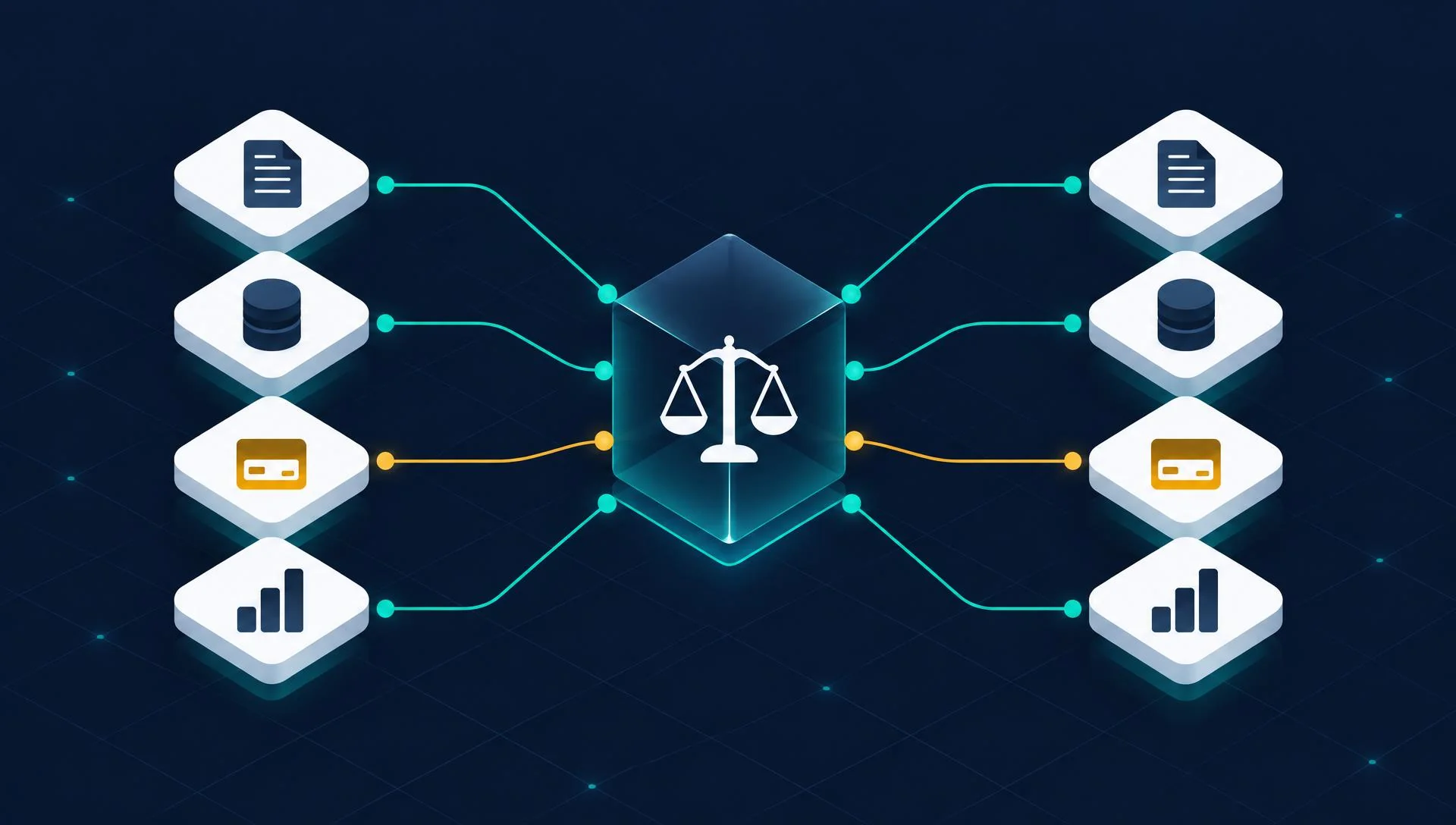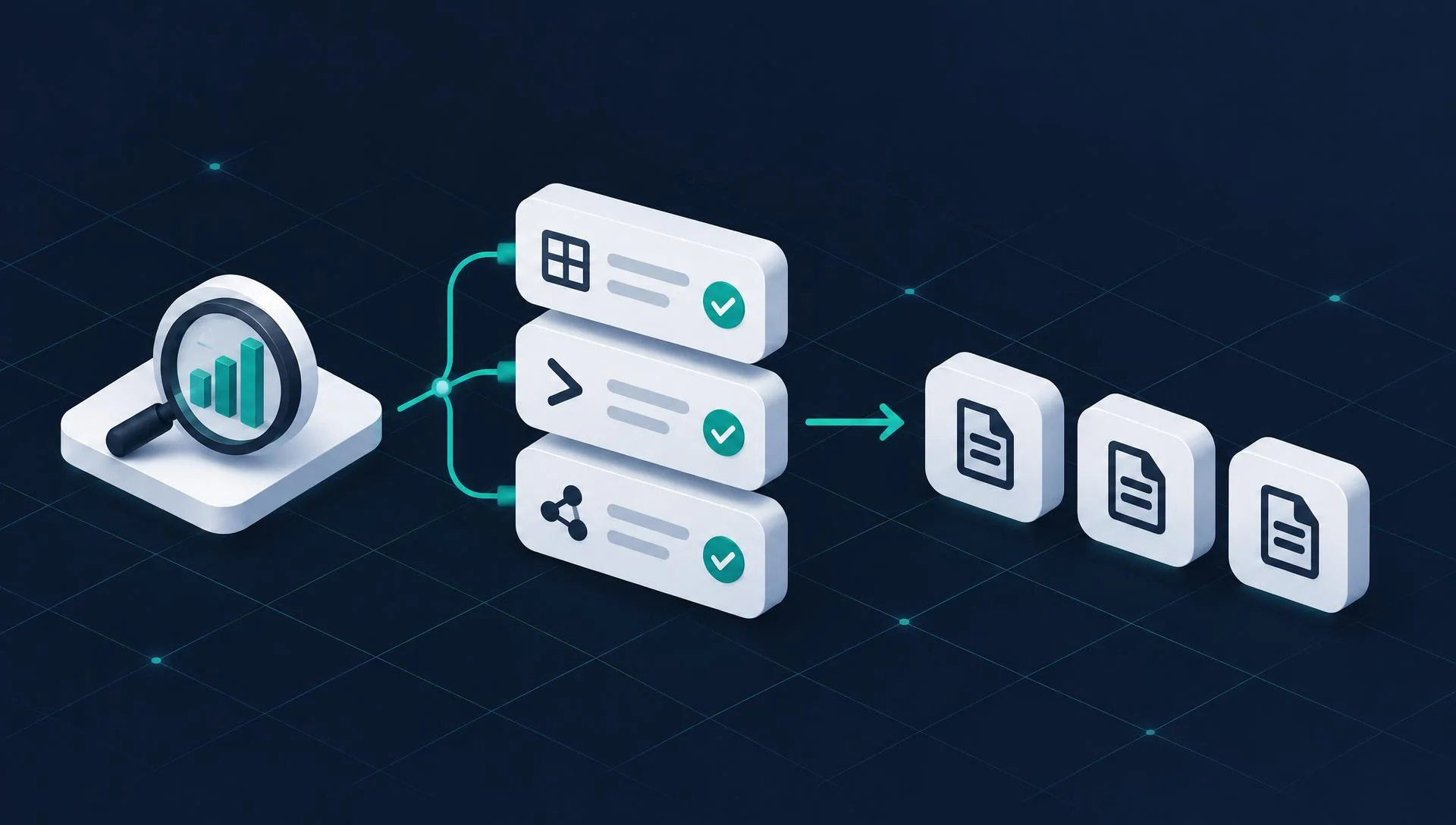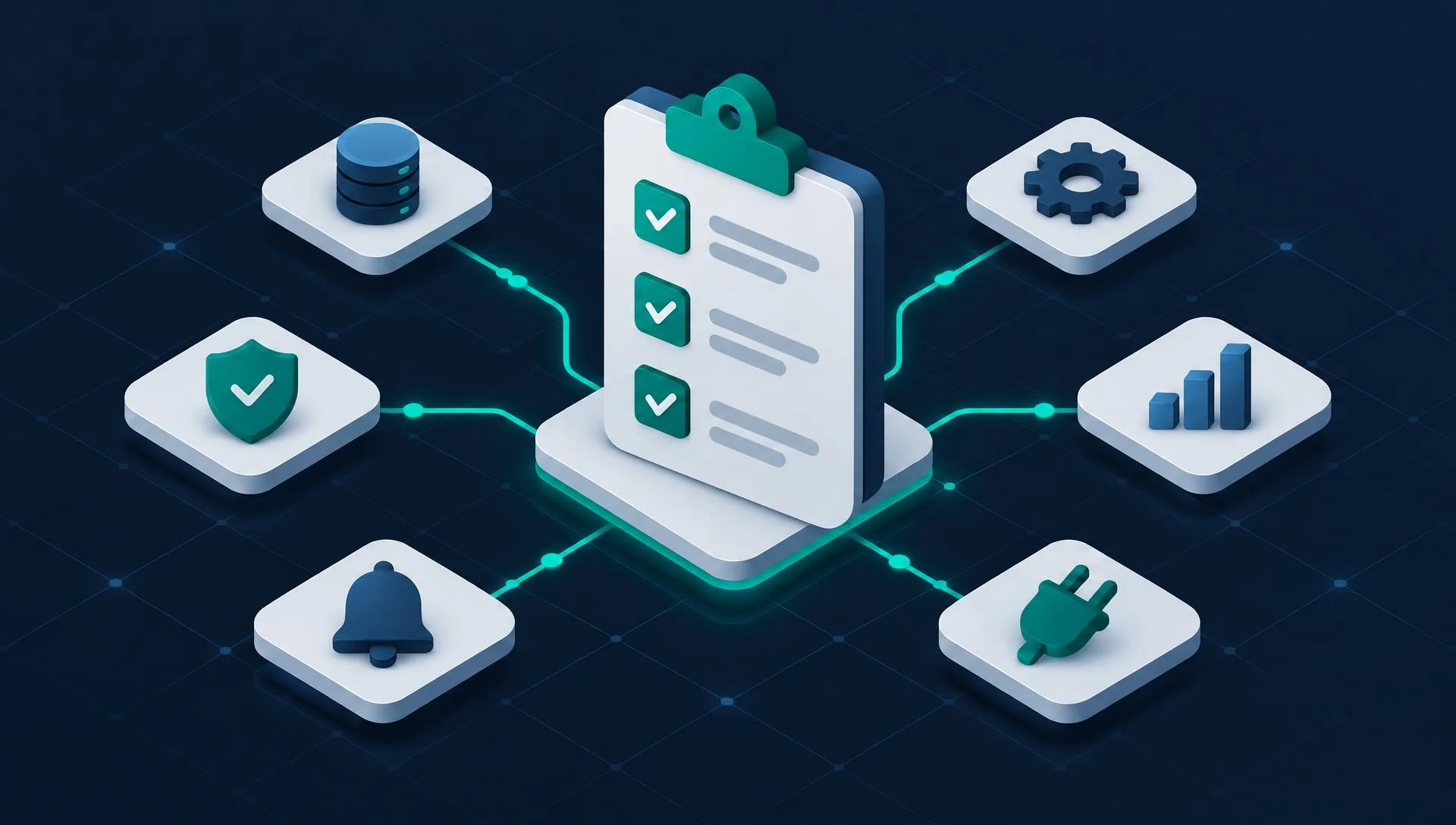
A data quality platform should help a team define requirements, test data against them, investigate exceptions, and retain evidence of the result. The right feature set depends on the data, the business decision, and the operating model. A long list of capabilities is useful only when buyers can see how those capabilities work together.
Start with the control that matters
For a financial reporting team, the priority may be reconciliation from a source ledger to a reporting table. For a customer operations team, it may be complete and valid contact details. For an AI team, it may include approved definitions, suitable data populations, and controlled access.
Write one acceptance scenario for each material risk. State the systems, data grain, expected checks, investigation owner, and evidence required. Use those scenarios throughout vendor evaluation.
Evaluate seven capability areas
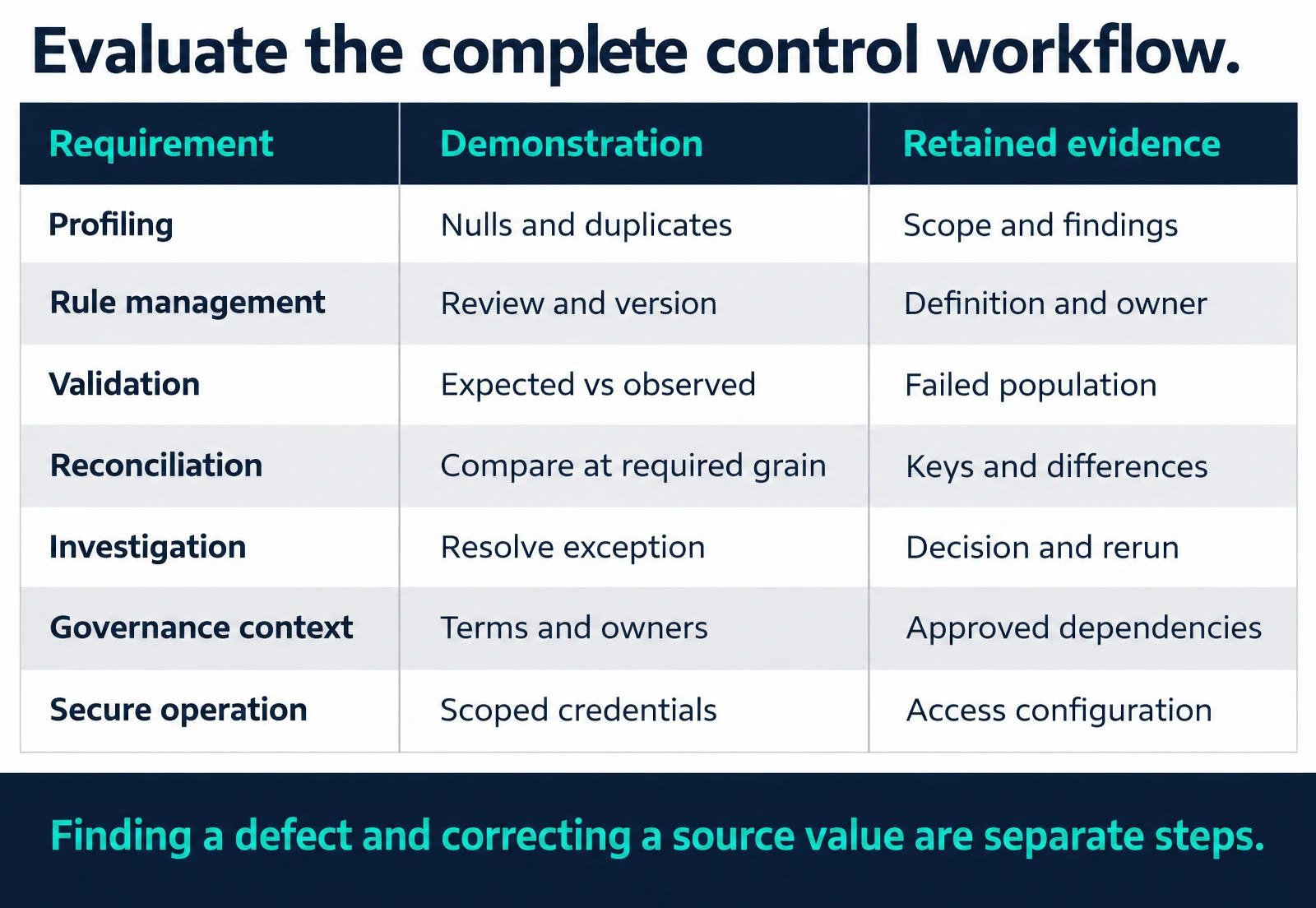
| Capability | What to demonstrate | Evidence to retain |
|---|---|---|
| Profiling | Detect nulls, duplicates, distributions, and relevant patterns | Scope, run time, sample or full population, findings |
| Rule management | Review, approve, version, and reuse a requirement | Rule definition, owner, version, exception policy |
| Validation | Evaluate data types, values, relationships, and business logic | Expected result, observed result, failed population |
| Reconciliation | Compare sources and targets at the required grain | Keys, mappings, tolerances, and differences |
| Investigation | Assign and resolve an exception | Owner, decision, rationale, and rerun link |
| Governance context | Connect terms, assets, owners, and changes | Approved definition and relevant dependencies |
| Secure operation | Demonstrate scoped credentials and permitted results | Access configuration and relevant activity records |
These are evaluation requirements, not a claim that every vendor or RightData product includes every capability in every configuration.
Separate finding an error from correcting it
A test may detect that a customer record contains an invalid country code. Correction requires an authorized process to determine the right value, update the appropriate system, and preserve the history. Do not assume that detecting a failed rule means the platform automatically cleanses the source.
Ask where remediation happens and who approves it. If the workflow exports a failed record for correction elsewhere, evaluate that handoff. A controlled external correction process can be appropriate; the important point is to understand it.
Test AI suggestions before approving rules
An AI-assisted profiler might suggest that a column is an identifier because its values are mostly unique. That does not establish that every duplicate is invalid. The dataset could contain versions, line items, or a legitimate many-to-one relationship.
Ask a reviewer to inspect the grain, business meaning, sample exceptions, and expected population before activation. A useful rule repository records the approved meaning and its limits, so a later user does not reuse a rule in an incompatible context.
Run a proof of concept with known defects
Create an illustrative test population containing one missing record, one duplicate business key, one invalid reference, and one transformed value error. Keep the expected answers independently documented. Then add a legitimate exception, such as a pending record that is not yet required to have a completion date.
The platform should make the difference between a defect and an approved exception visible. Review execution impact on source systems, result access, and the effort required to explain a failure. Repeat the test after a mapping change to see whether the historical evidence remains understandable.
Map RightData capabilities to the correct product
RightSight supports the governance and metadata context around quality work, including profiling, AI-assisted rule review, reusable rules, and quality workflows. DataTrust focuses on continuous data quality assessment and controls, validation, ETL testing, and reconciliation. DataMarket supports discovery and authorized consumption of governed data products.
Use that division as the starting point for a demonstration, then confirm the specific connectors, permissions, execution modes, and evidence your implementation requires. Product scope should be established by the demonstrated workflow, not inferred from a broad platform label.
Read data quality rules examples for a reusable control specification and the ETL automation guide for source to target testing.
Frequently asked questions
What is the most important data quality platform feature
The ability to produce usable evidence for your highest-risk requirements matters more than an isolated feature. Test the full path from a defined requirement to an investigated result.
Does a quality platform need to cleanse source data
Not necessarily. It needs a clear remediation workflow. Corrections may occur in the source application, a managed transformation, or another authorized process.
How should AI-assisted rules be evaluated
Check the proposed rule against business meaning, grain, known exceptions, and representative data. Require an accountable reviewer before the suggestion becomes an active control.
Request a Demo using a documented control scenario and a small set of known defects.