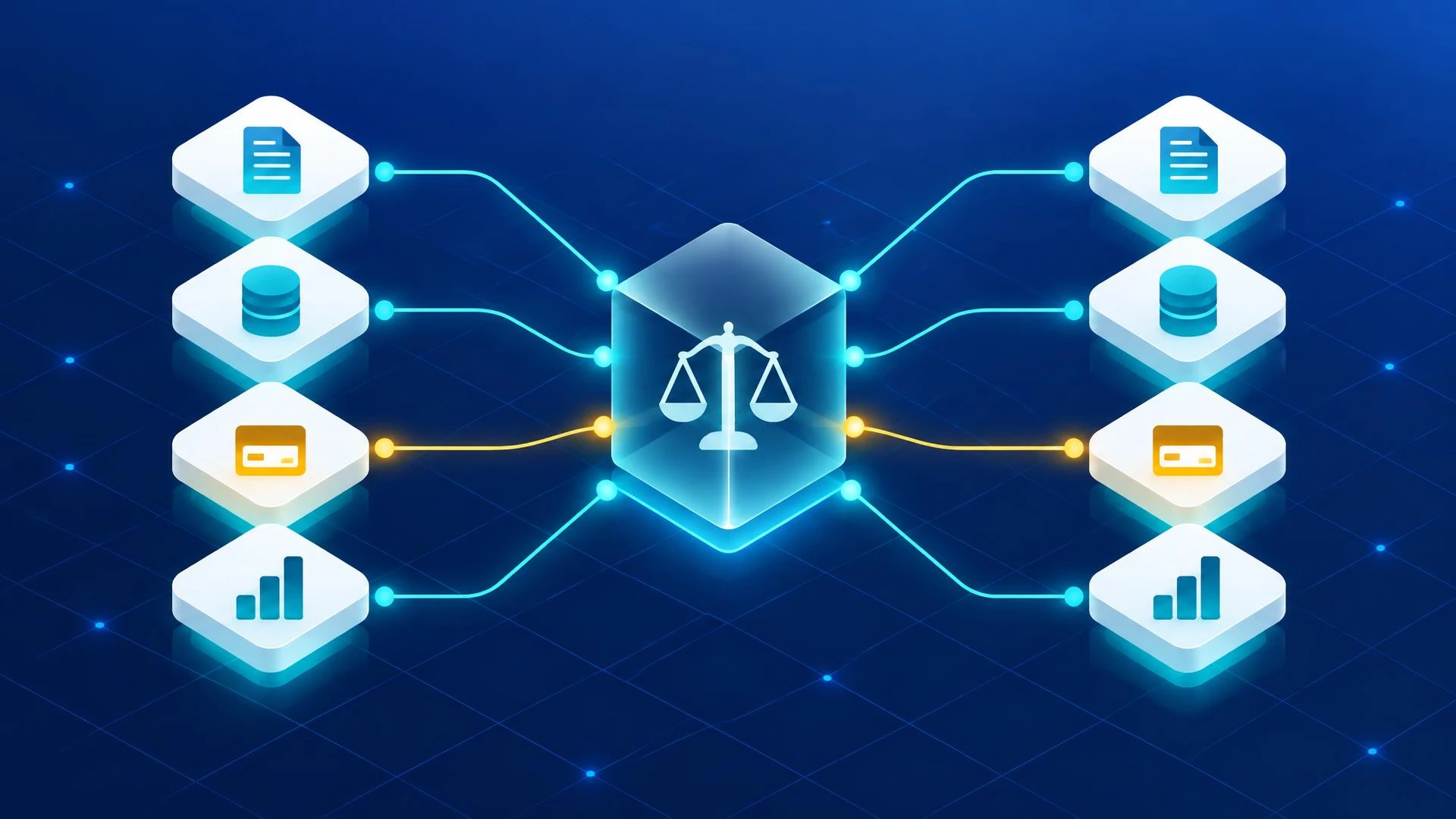
A data reconciliation tool compares defined populations to identify agreement and differences between systems or outputs. An enterprise evaluation should establish the comparison grain, supported transformations, timing model, exception workflow, and evidence available for review.
Start with the control you need to operate. A product that compares totals may serve one purpose while a process requiring record-level explanations needs additional coverage.
Select the right comparison grain
| Comparison | Useful question | Limit to acknowledge |
|---|---|---|
| Aggregate | Do scoped counts or totals agree | Offsetting record errors can remain hidden |
| Key population | Are expected business keys present | Values can differ on matched keys |
| Record and field | Which matched values differ | Mapping and normalization must be defined |
| Transformed result | Does the target match an independent expectation | Reusing the same flawed logic can conceal a defect |
Ask the vendor to demonstrate the grain required by the actual control. Do not assume a summary dashboard can explain individual differences.
Test a matching total that hides an error
Use two illustrative records. Record A is 100 in the source and 110 in the target. Record B is 200 in the source and 190 in the target. Both totals equal 300, yet both records differ.
A useful proof of concept should identify the affected keys and amounts. It should also preserve the definition of the comparison so a reviewer can understand why the aggregate passed while the field-level control failed.
Define transformations and permitted differences
Reconciliation does not always mean byte-for-byte equality. Systems may aggregate, convert currency, normalize codes, or apply approved exclusions. Record that expected relationship explicitly.
Test missing lookup values and rounding boundaries. A permitted difference should have a business basis, unit, threshold, and owner. Avoid broad tolerances that allow missing records or incorrect transformations to disappear inside an acceptable aggregate variance.
Evaluate timing and incremental behavior
Two systems can both be correct at different moments. Align business dates, timezones, extracts, and processing cutoffs. Define treatment for records still in transit, replayed changes, updates, and deletions.
Ask how the tool identifies the population compared in a rerun. If the source changed since the original failure, the reviewer needs to distinguish a correction from a different input population.
Inspect the exception workflow
Investigators need the business key, failed requirement, expected and observed values, and relevant mapping context. They also need an accountable route to decide whether the issue is a source defect, a target defect, a mapping error, or a valid difference.
Check how an accepted exception is approved and reviewed. Check whether the original failure remains linked to a later corrected run. A downloadable difference file can be useful, but its permissions and handling should be appropriate for the underlying data.
Evaluate a financial reporting reconciliation scenario
For a bank comparing a transaction source with a reporting dataset, define the reporting population before comparing amounts. State the business date, currency, transaction status, reversal treatment, and included entities. A difference caused by an agreed exclusion should be explainable from the specification. A difference that nobody can explain should remain an exception.
Ask the vendor to compare transaction keys as well as balances. An omitted debit and an omitted credit can leave a net total unchanged while the population is incomplete. Include a reversal, a late transaction, and a duplicate transmission in the demonstration. The expected answer should state which records belong in the report and how each amount contributes.
Review what an investigator actually sees. A useful result connects the exception to the source reference, target reference, control version, and approved mapping. If the reporting population contains sensitive information, test whether exception access follows the required restrictions. A successful comparison does not justify distributing unrestricted copies of the underlying records.
Use a reproducible evaluation scorecard
Evaluate five known cases: a missing key, duplicate key, transformed amount error, valid timing difference, and rerun after correction. Score each case only after it has been demonstrated. Record connection requirements, execution impact, processing time for the representative scope, and reviewer effort.
Keep security and commercial review distinct from the functional result. Confirm supported systems, credential scope, data handling, retention, deployment model, and pricing against the current proposal. Do not infer those facts from a category label or an old comparison page.
Compare execution methods and operating costs
Ask where comparison processing occurs and which data moves between environments. Execution near the source, execution in a target platform, and extraction into another service can have different permission, performance, and data-handling implications. Request an architecture walkthrough using the proposed deployment rather than accepting an unspecified claim of scale.
Measure the representative workload with the agreed comparison depth. A fast aggregate check cannot be used as the performance benchmark for a later record-level comparison. Record population size, field selection, partitioning, concurrent workload, and the time required to retrieve actionable differences. Repeat the exercise when the source is under realistic operating load.
Estimate ongoing effort as well as licensing. Include mapping maintenance, rule changes, investigation, evidence retrieval, upgrades, and administration. Establish who owns each task. The evaluation becomes more useful when two vendors are asked to operate the same control under the same conditions, with commercial assumptions recorded separately.
DataTrust focuses on continuous data quality assessment (DQA) and data quality controls (DQC), validation, ETL testing, and reconciliation. Request a demonstration using your comparison grain and evidence requirements. For implementation steps, read automated data validation; for migration decisions, use the cutover checklist.
Check the evidence retrieval experience after the demonstration. Ask a reviewer who did not run the test to explain one failed transaction using the retained record. If that person needs the engineer to reconstruct the scope or mapping, the evidence is not yet sufficient for independent review. Document what additional context is needed and who will maintain it.
Include a changed permission in the evaluation. Verify that a user who loses access can no longer retrieve sensitive difference records through the supported interface or export path. Functional comparison accuracy and controlled access to the resulting evidence are separate acceptance requirements.
Use acceptance criteria that a reviewer can verify
Write a pass condition for every demonstration case. For a missing key, require the tool to identify that key within the eligible scope. For an accepted rounding difference, require the displayed tolerance and its unit to match the approved rule. For a corrected rerun, require a traceable connection to the original failure.
Record unsupported cases explicitly. A manual step can be acceptable if its owner, access requirements, and workload are understood. Treat a capability that needs customization differently from one demonstrated in the proposed configuration. This prevents a feature checklist from overstating what the operating team will actually receive.
Frequently asked questions
Why are matching totals insufficient
Different record-level errors can offset each other. Match the test grain to the business risk and inspect keys and values where individual accuracy matters.
Should a tool compare transformed data
Where the control requires it, the evaluation should establish how mappings and expected transformations are defined, versioned, and tested. Raw equality may be inappropriate.
What evidence should a reconciliation retain
Useful records include scope, input references, keys, mappings, tolerances, execution version, results, differences, owner decisions, and rerun links.
Request a Demo with representative data and known differences so the result can be evaluated independently.