I have always found the phrase “data quality” slightly misleading. It sounds binary. In reality, data is almost always contextual. A customer record good enough for a marketing segment may be unfit for a compliance report. A product hierarchy may support a dashboard but break a forecasting model. A column can pass every null, range, and schema check and still be wrong for the business use.
That gap matters more as companies move from analytics to AI. Dashboards tolerate ambiguity. AI agents do not. An agent recommending an action, resolving a customer issue, or triggering a supply chain workflow needs more than a table that loaded successfully. It needs context: meaning, origin, owner, freshness, policy, allowed usage, and historical trust.
That is why I think the next evolution of quality is not another rule engine. It is a data quality agent.
A rule engine asks, “Did this value violate a condition?”
A data quality agent asks, “Should anyone trust this data for this purpose?”
For years, data quality programs have been built around known problems: missing values, invalid formats, duplicates, broken reference data, failed reconciliations. Keep those. We should not romanticize AI to the point where we ignore basic checks.
But rules only catch defects we can describe in advance. The harder issues are contextual. Revenue looks stable in total, but one region silently stopped reporting. A supplier file arrives on time, but the classification logic changed upstream. A table is complete, but the attributes needed by a model are stale or restricted. These problems require reasoning, not just validation.
A data quality agent sits above traditional controls. It reviews profiling patterns, lineage, usage, incidents, stewardship notes, policy tags, and previous quality outcomes. It might say, “This dataset passed schema checks, but it has not refreshed in three days, the upstream source changed, and the consuming model is sensitive to this attribute.” That is very different from a green check mark.
The point is not that the agent magically fixes quality. It makes quality work more intelligent.
Think about good data stewards. They compare current behavior with business context. They know which issues matter and which are noise. They know who owns the data and who to call when it breaks. They translate technical defects into business impact. But expertise does not scale across thousands of pipelines and millions of attributes. AI agents give us a way to scale this judgment without removing humans from the loop.
A practical data quality agent could do five things well.
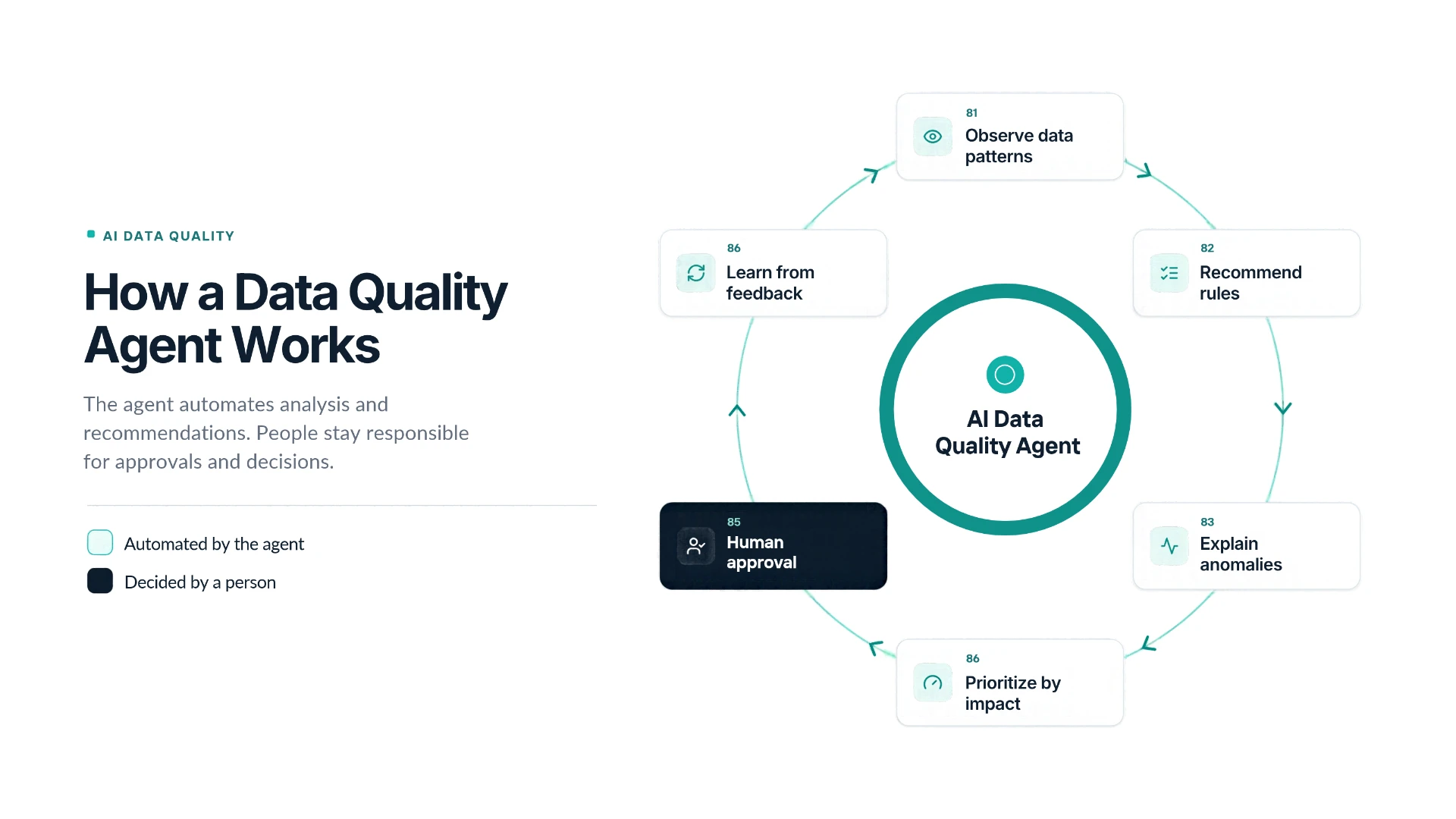
First, discover quality expectations from the data. Instead of waiting for someone to write every rule, the agent observes patterns and recommends checks: expected ranges, valid categories, normal volumes, freshness windows, common joins, and uniqueness assumptions. A human approves, but the blank page goes away.
Second, explain anomalies in business language. “Column X deviated by 22%” is useful to an engineer. “West region orders dropped because the distributor feed did not arrive after Friday’s release” is useful to everyone. The agent should connect monitoring, lineage, and operational context so teams can move from detection to diagnosis faster.
Third, prioritize based on usage. Not every defect deserves the same attention. A field used in a board metric, regulatory report, or production AI agent should be treated differently from an exploratory attribute. Quality needs a sense of consequence. This is where usage telemetry, trust signals, and business criticality become essential.
Fourth, make quality rights-aware. Some issues are inseparable from access and policy. A dataset may be accurate but not appropriate for a user, region, model, or purpose. As agents become data consumers, quality must include the question: “Is this data permitted for this use?” Trust and rights cannot remain separate governance exercises. They have to travel with the data.
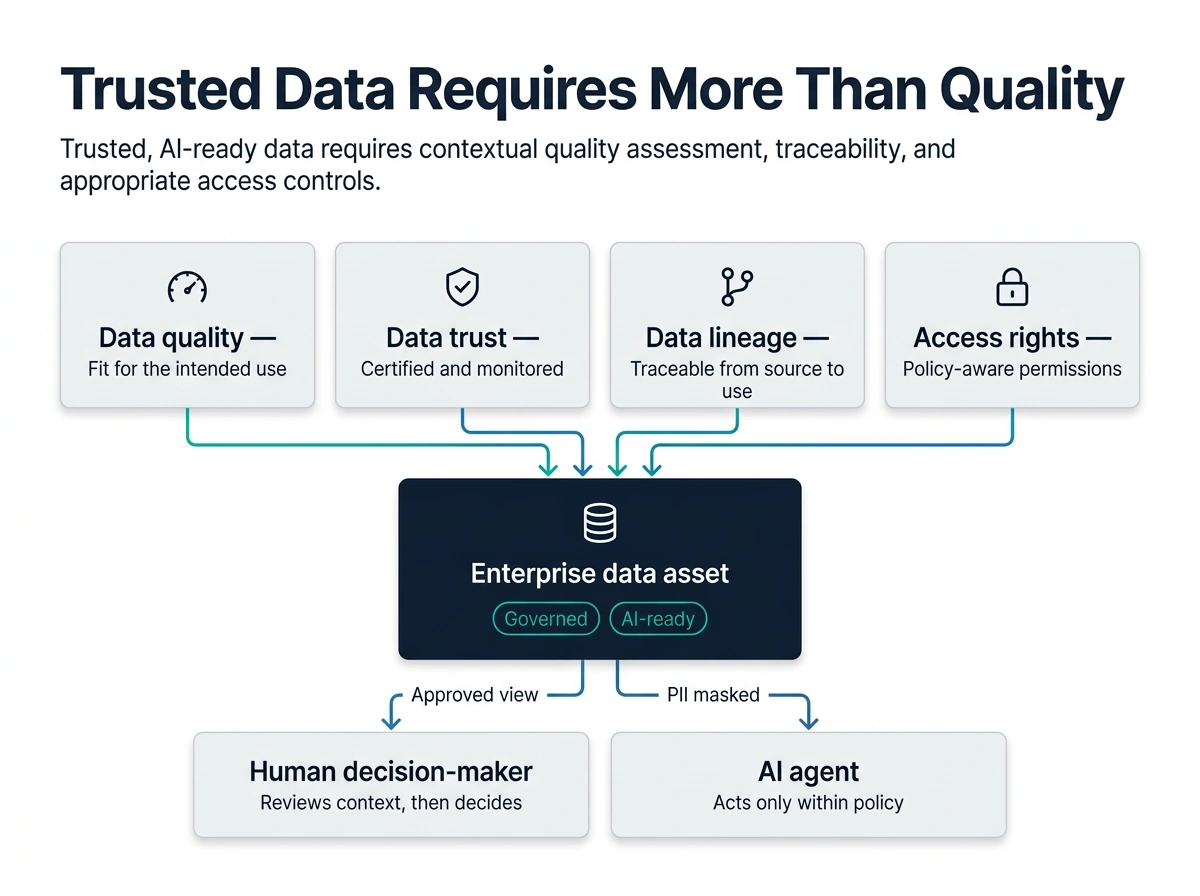
Fifth, create a feedback loop. When a steward accepts a recommended rule, rejects a false alarm, certifies a data product, or documents a known limitation, the agent learns the operating pattern. Over time, one agent’s work improves the next agent’s starting point. That is “robots building robots” in data management: agents creating better metadata, better rules, better trust signals, and better context for other agents and people.
This matters because AI-ready data is not a one-time cleanup. It is a living system. The data estate changes daily. New sources come in. Policies evolve. Pipelines shift. Business definitions change. Models start consuming attributes never designed for automated decisioning. A static certification from six months ago means little if the data has changed ten times since then.
Agentic quality lets readiness become continuous.
But there is a trap. The goal is not an all-powerful agent that declares “trusted” or “not trusted.” That just replaces one oversimplified badge with another. Better design makes trust explainable. Why is this data trusted? For which use case? Based on which checks? Under which policies? With what known limitations? Who approved it? When was it last observed behaving normally?
The output should not only be a score. It should be evidence.
Organizations also need to be honest about accountability. Agents can recommend, detect, summarize, route, and learn. They can reduce manual effort and make stewardship more consistent. But they should not become an excuse for unclear ownership. If anything, agentic data quality makes ownership more visible. When an agent finds a problem, someone still decides whether it is acceptable, urgent, or business-changing.
The mature organizations will not use AI agents to bypass governance. They will use agents to make governance executable.
That is the real shift from rules to reasoning. Rules remain the foundation, but not the whole story. Enterprises need quality that understands context, consequence, access, lineage, and intended use. Quality must serve both human decision-makers and machine decision-makers. Systems need to say not only whether data passed a check, but whether it is ready to be trusted.
The irony is that more AI means more discipline in data management. AI does not eliminate data quality. It raises the standard.
The data quality agent is not a futuristic add-on. It is a practical bridge between today’s rule-based controls and tomorrow’s AI-ready enterprise. Companies that understand this will stop treating quality as back-office cleanup and start treating it as part of the AI operating model.
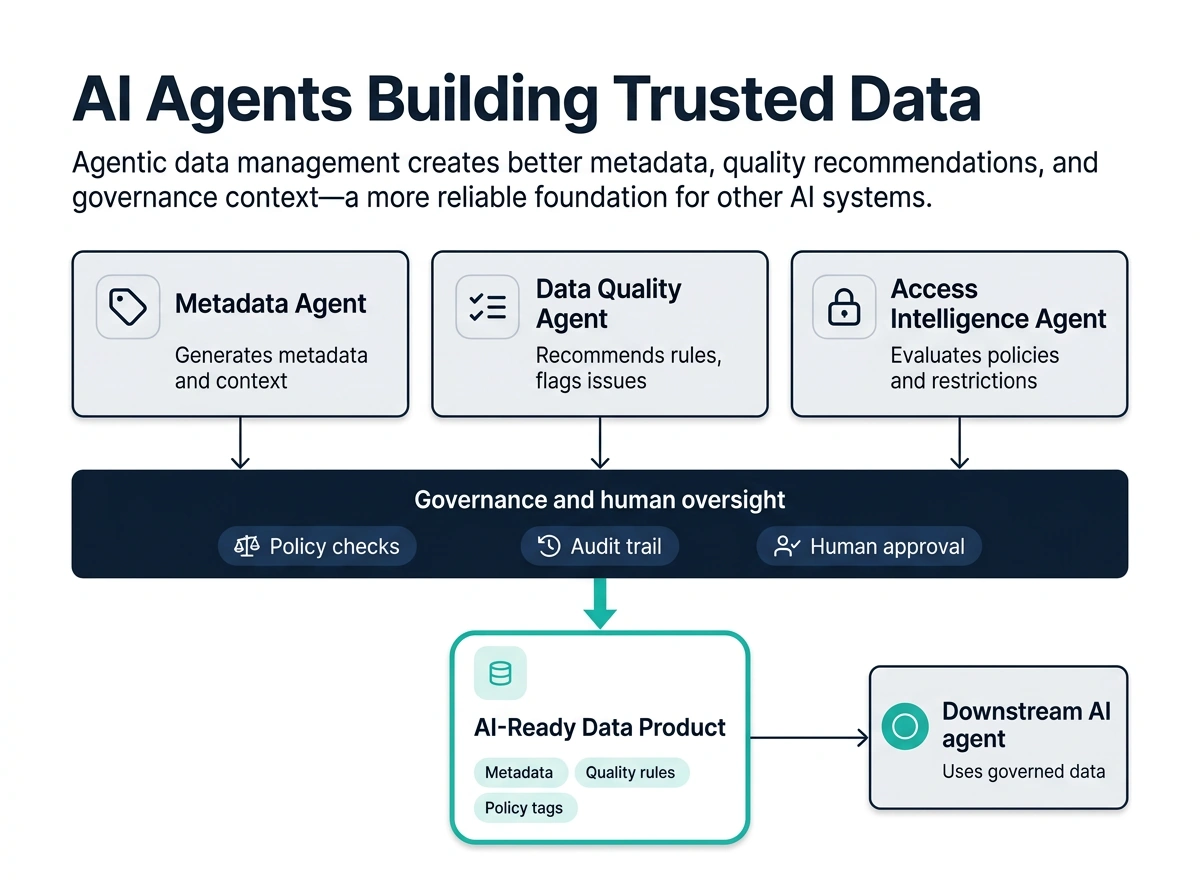
AI will not run on data alone. It will run on trusted, governed, explainable data. Getting there requires agents that can reason about quality, not just check for defects.
Frequently asked questions
How is a data quality agent different from a traditional rule engine?
A rule engine evaluates explicit conditions such as required values, valid codes or reconciliation tolerances. A data quality agent can help interpret observations in context, propose checks and explain issues for review. Its usefulness depends on the evidence available and the limits of its authority. Established validation rules remain part of the control design.
Should a data quality agent approve or activate its own suggested rules?
A suggested rule should be reviewed for business meaning, eligible population, comparison grain and valid exceptions before activation. Define who can approve it and which actions require a separate decision. An apparently normal pattern in historical data is a candidate expectation, rather than sufficient evidence of an approved business requirement.
What evidence should support an agent’s quality recommendation?
Retain the relevant dataset and observation time, profile or test results, applicable business definition, affected population and explanation of the proposed action. Identify any missing context. A reviewer should be able to trace the recommendation to evidence and distinguish an observed defect from an inference that still needs investigation.
Does a high quality score mean data is suitable for every AI use case?
No. Suitability depends on the intended task, population, freshness, definitions and permitted use. A score based on selected checks may omit a critical requirement for another task. Evaluate the specific inputs and consequences of the AI workflow, including limitations that a general dataset score does not capture.
How should a team evaluate a data quality agent before deployment?
Use a reference set containing known defects, valid exceptions, ambiguous definitions and missing evidence. Review detection, explanation, prioritization and proposed actions separately. Check that the agent acknowledges uncertainty and routes material decisions to the accountable owner. Compare its output with approved expectations rather than judging only fluency or speed.