Unstructured data governance defines how documents and other unstructured assets are owned, classified, approved, accessed, reviewed, and retired. For enterprise AI, those controls help determine which sources a system should retrieve and how a user can verify an answer.
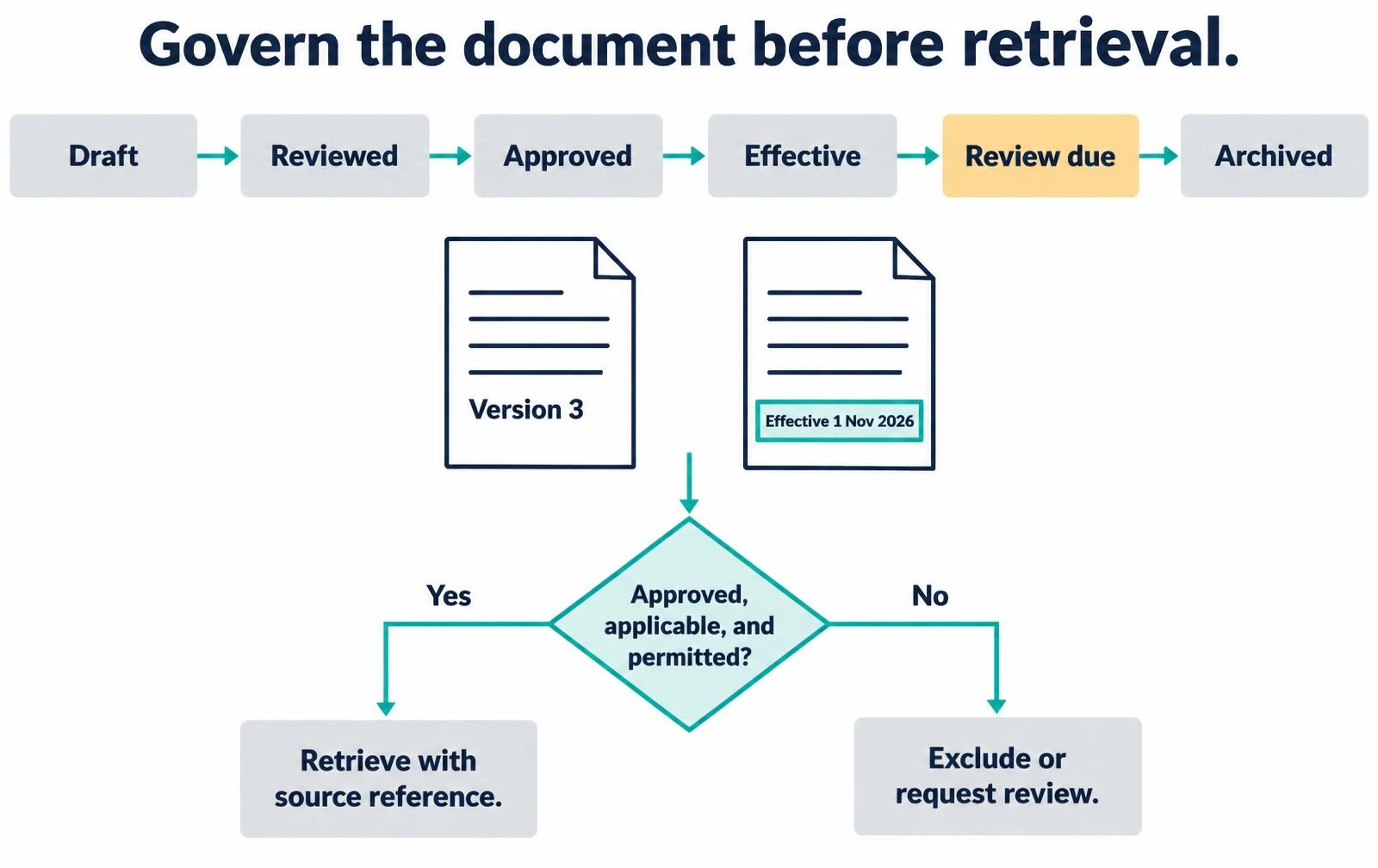
Finding a relevant paragraph is insufficient if it comes from an expired policy, an unapproved draft, or a document the user is not authorized to access. Governance needs to operate across the document lifecycle and the retrieval path.
Start with a document register
Inventory the repositories used for the initial use case. Assign an accountable owner and distinguish the authoritative source from convenience copies. Record document identifiers, business purpose, sensitivity, approval status, effective date, review date, and permitted audience.
Choose a narrow pilot, such as approved employee travel policies. A focused register is more useful than importing every file and assuming that relevance ranking will identify the authoritative version.
Make approval and validity explicit
Consider an illustrative travel policy with two versions. Version 3 permits a hotel allowance of 180 per night. Version 4 changes the allowance to 160 and takes effect on 1 November. The correct source depends on the policy's applicability and effective date, not simply which file was uploaded most recently.
Store both version history and a clear current-use status. A draft should not become authoritative because it has a newer timestamp. Preserve historical material where required, but distinguish historical retrieval from current policy advice.
| Metadata field | Illustrative value | Retrieval purpose |
|---|---|---|
| Document owner | People Operations policy owner | Assign review responsibility |
| Approval state | Approved | Exclude unapproved drafts from current policy answers |
| Effective date | 1 November 2026 | Select the applicable policy period |
| Review date | 1 May 2027 | Trigger a review of continued suitability |
| Permitted audience | Employees in the defined jurisdiction | Enforce audience boundaries |
| Source reference | Document identifier and version | Support verification and correction |
These fields are an example operating specification, not a guarantee that a particular platform enforces every control automatically.
Apply permissions throughout retrieval
Authorization should govern the source, indexed content, snippets, and any downstream answer or export. A restricted document must not become visible through a search preview merely because the full file remains protected.
Test two users with different access rights against the same question. Verify the permitted document population, displayed snippets, and generated response. Include a user whose access has been revoked to check whether cached results or indexes are refreshed appropriately.
Treat generated content as a result to verify
An AI summary can misstate a qualification or combine incompatible versions. Retain a usable source reference, show the applicable version where possible, and design the workflow so the user can inspect the supporting passage. A citation alone does not prove the answer faithfully represents the source.
Define what happens when no approved source answers the question. A controlled response should state that the available material is insufficient and direct the user to the appropriate owner. It should not fill the gap with a plausible policy statement.
Keep a correction and retirement process
When an owner changes a policy, identify the authoritative update and the places it has been copied, indexed, or embedded. Refresh the relevant retrieval assets and test the old question again. Record who approved the change and what evidence confirms the updated behavior.
Retirement needs an explicit decision: archive, restrict, remove from current search, or delete under an approved retention process. Do not treat all old documents as errors or delete them solely because a newer version exists.
Connect governance to the RightData workflow
RightSight supplies metadata and governance context, while DataMarket supports discovery and authorized consumption of governed data products. Validate supported unstructured sources, permission propagation, version handling, and retrieval behavior in a scoped demonstration before claiming end to end document governance coverage.
For structured definitions used alongside documents, read the business glossary guide. For retrieval evaluation, read governed AI data discovery.
Frequently asked questions
Does the newest document always contain the applicable policy
No. Approval state, effective date, jurisdiction, and business purpose determine applicability. Upload time alone is not an authority rule.
Can a source citation prevent an incorrect AI answer
It helps users verify the answer, but it does not guarantee faithful interpretation. Check that the cited passage supports the claim and is applicable to the question.
What should happen when a document expires
Follow the approved review and retention process. Remove or flag it for current-use retrieval where appropriate, assign an owner, and verify the replacement before relying on it.
Request a Demo to explore a governed discovery workflow using an approved document set and defined user permissions.
Further reading
NIST Generative AI risk profile