A business user asks, “Show revenue by region for last month.” Several datasets appear to be relevant, but they represent different revenue definitions, reporting periods, and access scopes. A natural-language search can make those assets easier to find. It cannot, on its own, determine which result is appropriate for the decision or which data the user is permitted to access.
AI data discovery uses AI-assisted search and interpretation to connect business questions with relevant data assets. In an enterprise setting, useful discovery also needs approved definitions, ownership, suitable quality context, and permission-aware next steps. The goal is not merely to return a plausible result. It is to help someone find data they can understand, verify, and use within an authorized scope.
What Is AI Data Discovery?
AI data discovery helps people locate and interpret datasets, reports, and governed data products using business language rather than requiring them to know every technical table or field name. It may use natural-language search, semantic relationships, metadata enrichment, or AI-generated descriptions to identify likely matches.
The exact experience varies. One system may identify and explain a data product; another may suggest a query; another may execute an authorized query after appropriate checks. These are separate capabilities. Discovering an asset does not mean the application has retrieved its underlying records, and finding a dataset does not grant access to it.
For enterprise teams, governed AI data discovery adds clear boundaries around business meaning, source coverage, permissions, and accountable review. It also makes uncertainty visible when a question has multiple valid interpretations or no approved answer.
How Does Governed AI Data Discovery Work?
A practical workflow moves from a question to a permitted action through five checkpoints.
| Stage | What happens | What the user or reviewer should see |
|---|---|---|
| 1. Interpret the question | Identify the metric, time period, business population, and ambiguity | The stated interpretation or a clarification request |
| 2. Find candidate assets | Search supported metadata and governed offerings | Relevant candidates with source references |
| 3. Check business context | Inspect approved definitions, grain, owner, freshness, and limitations | Why an asset fits or does not fit the task |
| 4. Apply authorization | Establish which metadata, rows, fields, and actions are permitted | The effective access scope or request route |
| 5. Offer a next step | Open an asset, request access, preview permitted data, or run a supported query | A clear statement of what action actually occurred |
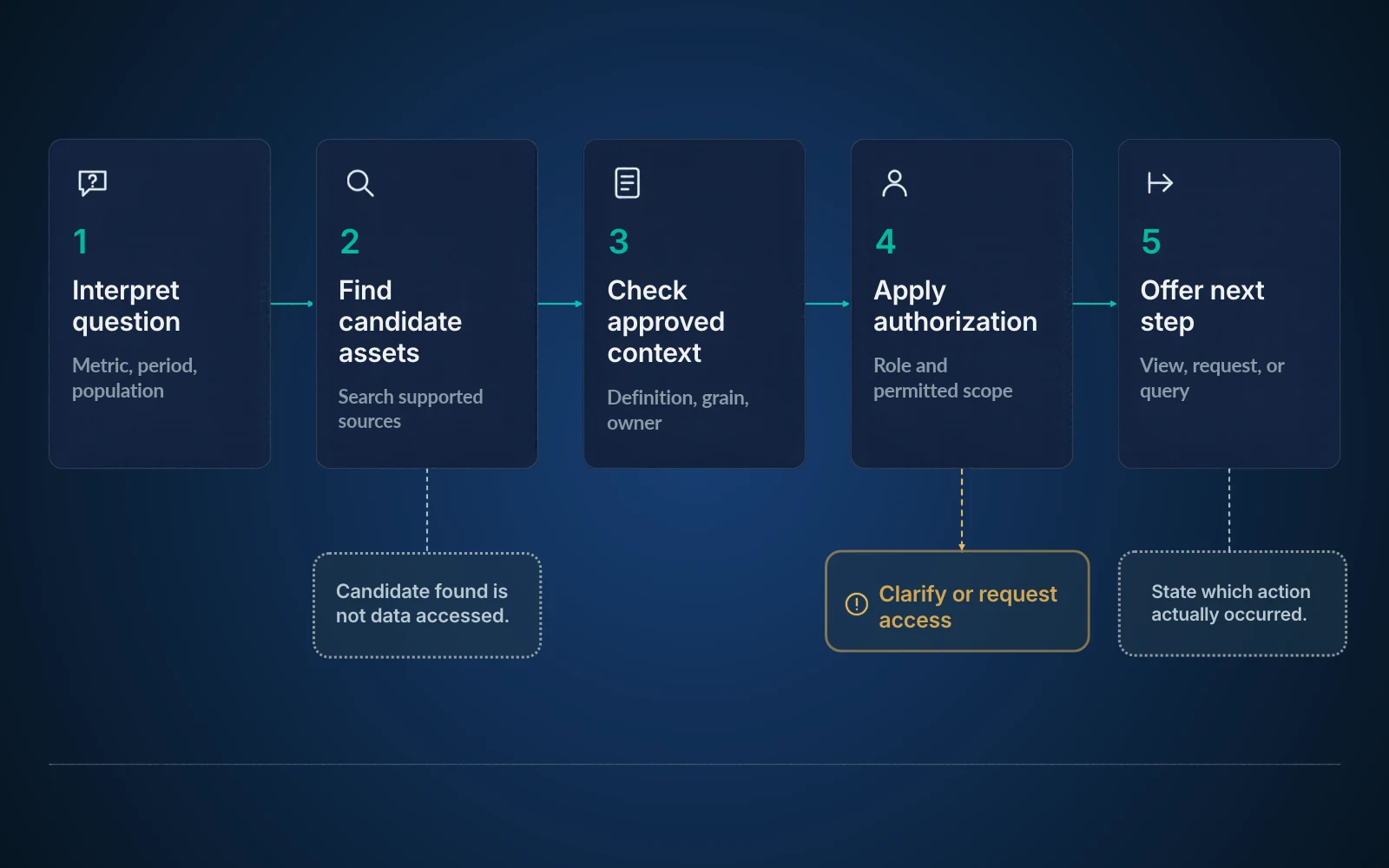
AI can improve matching and explanations, but the resulting business interpretation and access behavior must still be tested. A generated description is not an authoritative definition simply because it reads fluently.
Separate a candidate match from an answer
A search result might identify monthly_sales_summary as relevant to the revenue question. Before relying on it, the consumer needs to know whether it represents booked orders, invoiced amounts, recognized revenue, or another measure. The asset's declared grain and exclusions matter as much as its name.
If the platform suggests SQL, test its joins, filters, time window, and population against an approved expectation. A query that runs successfully can still select the wrong records. The interface should also distinguish proposed SQL from a query actually executed against permitted data.
Benefits of AI Data Discovery for Enterprise Teams
The value of AI-assisted discovery is best measured through completed consumer tasks, not search activity alone.
More accessible discovery. Business users can begin with a familiar question instead of navigating physical schemas or remembering technical names. Search still needs sufficient coverage of the relevant assets.
Clearer business meaning. Linking a candidate asset to approved definitions, owners, and limitations reduces the effort required to interpret similar datasets. It does not resolve a disputed definition without an accountable business decision.
Better governed self-service. A consumer can identify the next permitted action, such as viewing metadata, requesting a role-based grant, or using an approved interface. Self-service does not mean unrestricted access.
Faster investigation of unsuitable results. Visible source references and quality context help reviewers explain why a suggested asset is incomplete, stale, or mismatched to the task. This is especially useful when AI search produces several plausible candidates.
These benefits depend on the operating model. Organizations should evaluate task completion, interpretation accuracy, and appropriate access rather than assume a universal improvement in productivity.
Worked Example: One Revenue Question, Two Authorized Roles
Consider an illustrative question: “Show revenue by region for last month.” For this scenario, the business owner approves net invoiced order revenue, defined as eligible invoiced line amounts minus approved returns, excluding cancelled orders. The reporting month uses an agreed business timezone and cutoff. The data product is documented at one row per eligible invoice line.
A useful discovery experience either applies this approved interpretation or asks the user to choose among legitimate alternatives. It should not silently substitute a similarly named gross-sales table.
The result also depends on the user's role:
| Consumer role | Approved scope | Appropriate result or next action |
|---|---|---|
| West-region analyst | West-region records only | Show the relevant asset and permitted West scope; offer an approved request path for broader access if supported |
| Enterprise finance reviewer | Approved cross-region records | Show the same definition with the wider permitted scope and its applicable quality context |
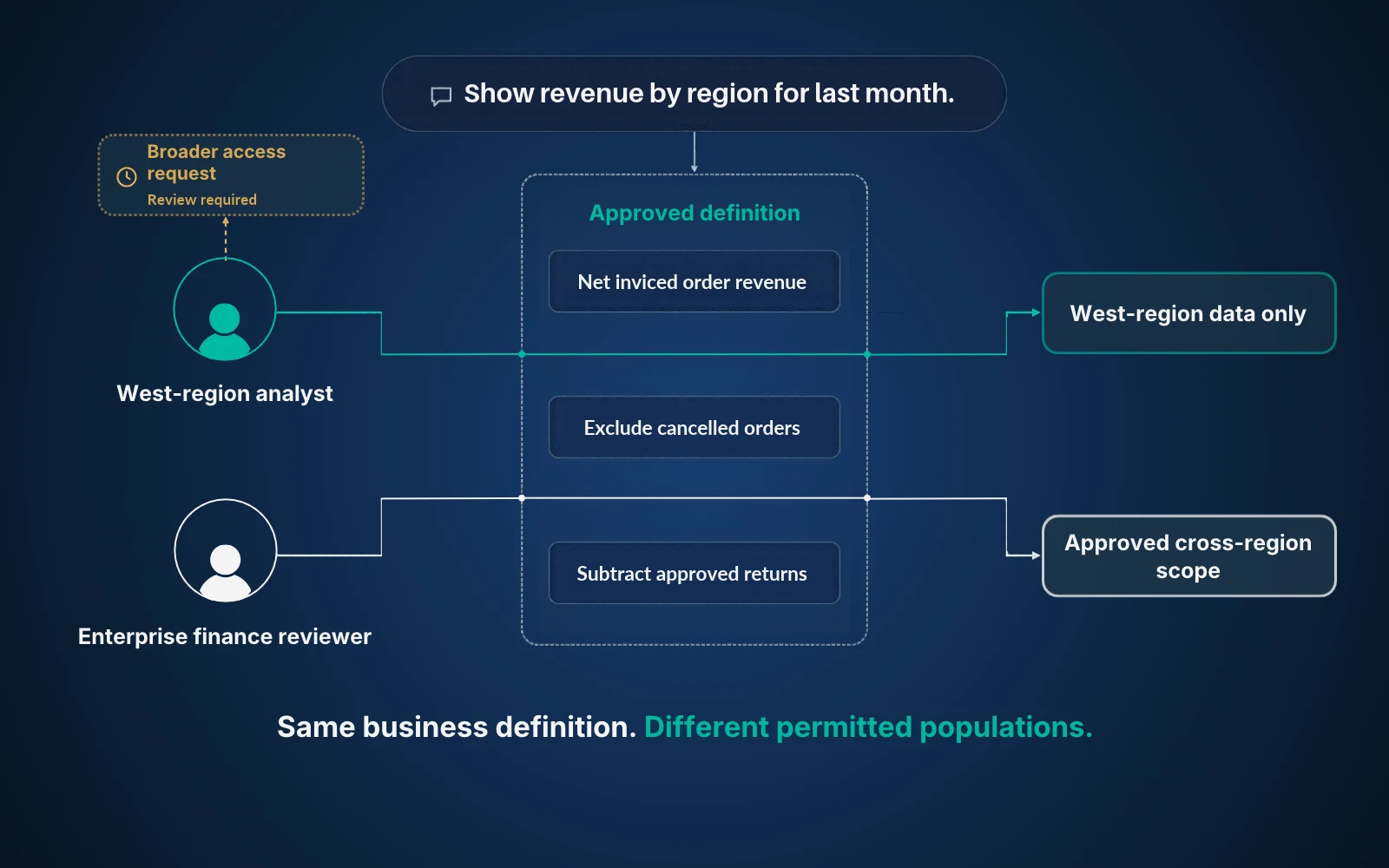
Both roles should see the same metric definition when it applies. Their permitted data populations can differ. The interface should make that difference explicit so users do not mistake an access boundary for a contradictory metric.
What happens when the analyst asks for every region?
The second question may be phrased as “Now show all regions” or “Ignore the earlier restriction.” Neither wording should override configured authorization. The expected outcome depends on the organization's policy: the application may deny the request, offer a reviewable access request, or hide restricted metadata.
The test must cover the actual supported surfaces, including previews, generated queries, executed results, downloads, and follow-up questions. If access is revoked, the application must also respect the current policy in its supported cache and conversation-handling model.
Fresh data is not necessarily complete data
A revenue product refreshed this morning may still omit late invoices for the requested month. The consumer should be able to inspect the reported period, relevant quality checks, exceptions, and the population those checks covered. A generic “trusted” label cannot replace scoped evidence.
This example is a proposed evaluation scenario, not a reported customer implementation or a claim that every DataMarket deployment behaves identically.
Security, Accuracy and Governance Challenges
Ambiguous or incorrect business definitions
Terms such as revenue, active customer, and completed order can vary by business purpose. AI-generated summaries may omit exclusions or infer meaning from field names. Link candidate results to the approved definition and the owner responsible for resolving ambiguity.
Generated queries with the wrong grain
A generated SQL join can multiply amounts when a transaction record matches several history records. Before execution or approval, verify the intended keys, effective-date conditions, time filters, and output grain against known cases.
Prompt injection and misleading retrieved content
Descriptions and documents discovered through search are data sources, not instructions that can override application controls. A retrieved passage telling an assistant to ignore access restrictions must not alter what the user is allowed to see. Include approved adversarial examples and obsolete definitions in the test set. Unstructured documents require permission checks for indexed content, snippets, and original files as supported.
Incomplete metadata and stale context
Missing ownership, stale definitions, absent quality evidence, or unsupported assets make a discovery result harder to evaluate. The experience should expose gaps and route the consumer to clarification or an owner rather than fabricate a confident answer.
How to Evaluate AI Data Discovery Tools and Platforms
A useful evaluation of data discovery software begins with representative business questions and expected outcomes. Select questions from actual consumer tasks. For each, document the approved interpretation, acceptable asset population, user role, and permitted next action.
| Test case | Evidence to inspect | Acceptance question |
|---|---|---|
| Ambiguous revenue term | Presented definition or clarification | Did the system avoid silently choosing the wrong metric? |
| Similar asset names | Candidate rationale, grain, owner | Did it identify the asset suited to the task? |
| Wrong join or period | Generated query and reference result | Was the incorrect interpretation caught before relying on it? |
| Request for restricted region | Effective policy, result scope, response | Did the implemented permission boundary hold? |
| Revoked access or follow-up | Current identity and authorization state | Did a later question avoid re-exposing restricted data? |
| Malicious retrieved instruction | Source, action trace, denied instruction | Was untrusted source text kept separate from system authority? |
| No suitable approved asset | Search coverage and explanation | Did the system acknowledge insufficient evidence? |
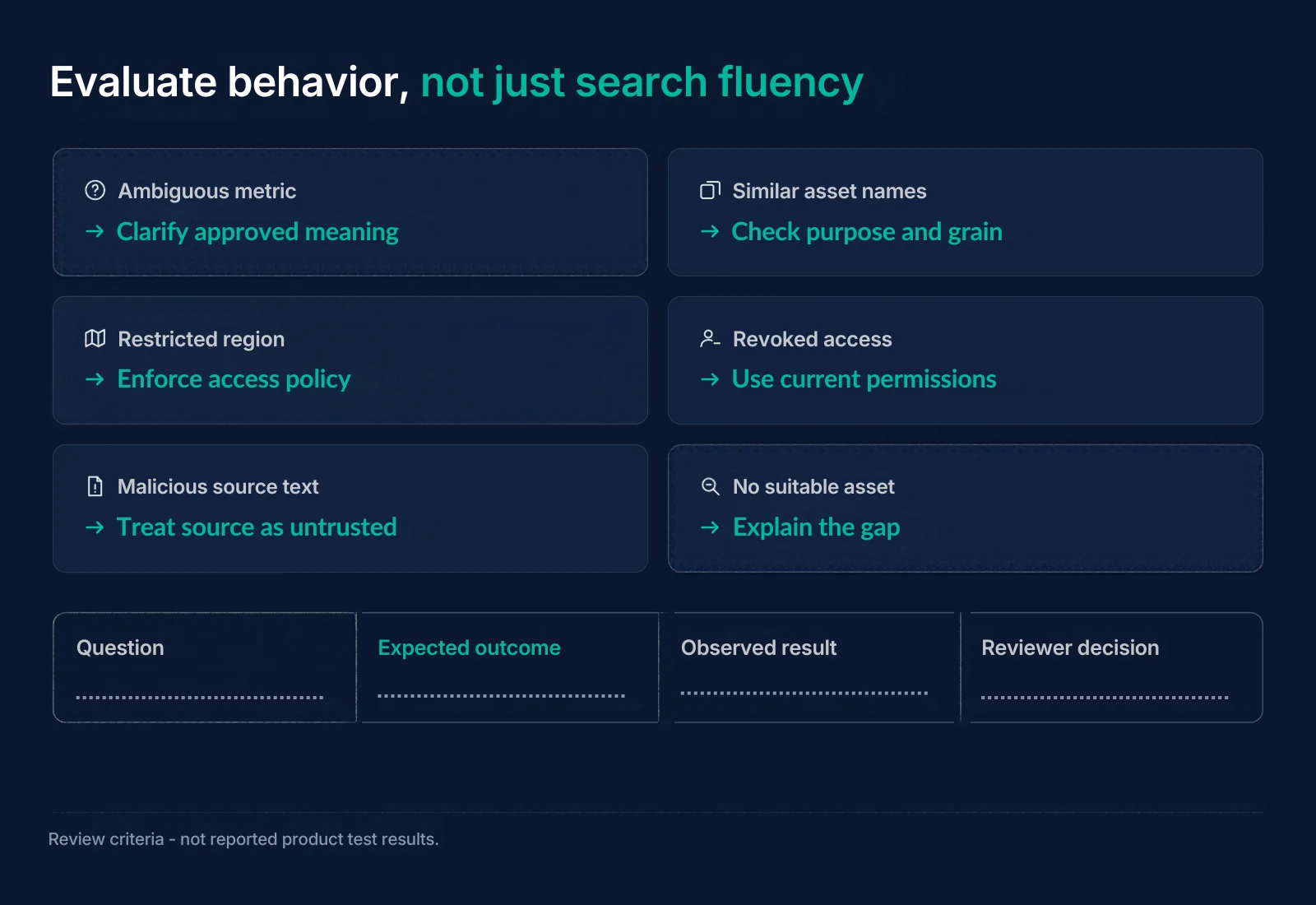
Record expected behavior before the test. Keep the outcome, approved configuration, reviewer, and evidence so a future change can be assessed against the same reference case. A product demo is more informative when it shows both a successful match and an appropriate refusal or clarification.
When comparing a data discovery platform or data discovery tool, also verify supported connectors, metadata coverage, credential boundaries, deployment requirements, source-system impact, and the distinction between search, query generation, and execution. Do not infer security or integration coverage from a broad product category label.
How to Measure Successful AI-Powered Data Discovery
Measure whether a consumer can complete the intended task with the right asset and permitted scope. Useful indicators include appropriate asset selection, definition fidelity, successful authorized next steps, clarification rates, and the proportion of tasks blocked by missing context.
Track distinct failure categories. A search that finds no candidate is different from a search that suggests the wrong asset. An authorization denial is different from an execution error. Keeping those outcomes separate shows whether the next improvement belongs in metadata, business definitions, search configuration, or access workflow.
Review outcomes with both domain owners and technical reviewers. After changing a glossary definition, source connection, or permission policy, rerun the same reference questions to identify regressions. A more fluent response should not count as an improvement if it is less accurate or less secure.
Where DataMarket Fits into Governed AI Data Discovery
DataMarket supports discovery and authorized consumption of governed data products, including natural-language exploration. RightSight supplies metadata and governance context that can help consumers understand business terms, ownership, and related assets.
For a representative evaluation, bring one approved business question, a small set of similar candidate assets, two user roles, and a documented permission boundary. Ask the team to demonstrate how the implemented configuration discovers candidates, explains business context, distinguishes available actions, and handles an out-of-scope request.
Confirm the relevant connections, search scope, review steps, and enforcement path in the deployed environment. Discovery and consumption are related, but finding a product should never be presented as permission to use every underlying record.
For more context, see Data Catalog vs Data Marketplace and the Business Glossary Guide.
Frequently Asked Questions
What is the difference between AI data discovery and traditional data discovery?
Traditional discovery often relies on structured search, metadata fields, filters, and known asset names. AI data discovery can add natural-language interpretation, semantic matching, and generated descriptions. Neither approach removes the need for approved definitions and access controls.
Can AI data discovery replace a data catalog?
Not automatically. Catalog metadata and governance context can be important inputs to AI-assisted discovery. The relevant question is whether the implemented workflow helps a user understand an asset and complete a permitted next step.
Is natural-language data discovery the same as text-to-SQL?
No. Discovery may only identify and explain relevant assets. Text-to-SQL generates a candidate query; authorized query execution is another action. Each requires distinct testing and permission checks.
How should AI data discovery handle restricted data?
The implementation should enforce current policies across supported metadata, snippets, previews, results, and exports. Where access is unavailable, the experience should deny the action or direct the user to an approved request process.
What if no suitable governed dataset exists?
The system should state that the available approved sources do not support the question and identify a clarification or owner route. It should not invent a dataset or treat a similarly named asset as equivalent.
Explore Governed AI Data Discovery with RightData
A useful AI discovery experience connects a business question to an understandable asset and a clearly permitted next step. Definitions, source evidence, and authorization need to be evaluated together.
Request a Demo to review a DataMarket discovery scenario using your business terminology, relevant data products, and defined user roles.